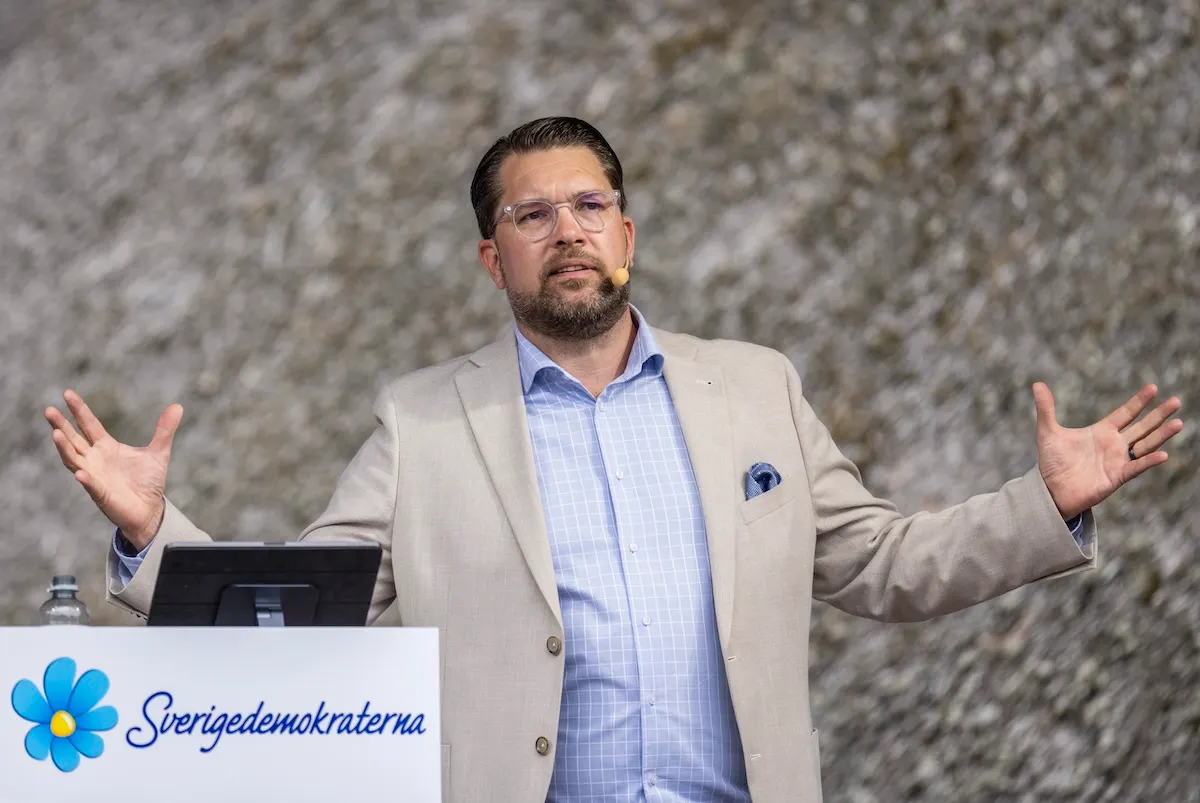
Whatever you think of Jimmie Åkesson’s politics – and I suspect many readers of The Local don’t think much of the Sweden Democrats’ leader – it’s hard not to conclude that he is a master manipulator of the media.
With only a few days left until the election, the polls have shifted dramatically in the right-wing bloc’s favour (even if the left-wing still retains a small lead).
The Christian Democrats are attracting voters across the bloc divide from the Social Democrats at the same time as more and more voters are ready to vote tactically to keep the Liberals in parliament. The party had the support of 3.5 percent of voters in a poll this week, just half a percentage point below the threshold the party needs to enter parliament.
If both trends continue, the right-wing bloc could pull off a comeback that will go down in political history.
There are several reasons you can cite for this change in fortunes: the Social Democrats’ lacklustre campaign, the Centre Party’s call for a centrist government including the Christian Democrats, the humdrum fact that the gap between the blocs always tends to tighten during the campaign.
But I suspect Jimmie Åkesson’s skilful playing of the Swedish media might be more significant than any of these.
When Åkesson spent several minutes of his summer speech on August 29th laying into Ebba Busch, the leader of the Christian Democrats, and she then dramatically rerouted her election bus to go and meet him in his home town of Sölvesborg, it felt like political theatre, or to use the wrestling term that Donald Trump has made a media cliché, kayfabe.
This is the duo, after all, whose famous lunch over meatballs showed how you can distract political reporters from political substance with details about the menu. This time, Busch arrived with a sockerkaka, a sponge cake from Småland.
It all felt fake, but I wrote up the story as if it were real and I imagine many other Swedish journalists felt and did the same: in a tedious campaign about tax cuts and sick leave, it was too juicy a morsel to ignore.
I had had much the same feeling when Åkesson announced, a few days earlier, that it was time to give up on the Liberals as a lost cause and gave the party’s leader Simona Mohamsson ten days to get over 3.5 percent before losing her right to tactical votes.
It was a completely arbitrary deadline and when the day came, Åkesson changed his tune anyway. Again, the Swedish media (including The Local) wrote it up as 'divisions within the Tidö bloc'. It was a race-against-time narrative and just too exciting to question too deeply.
So were we all a bunch of easy marks: Lättlurad, as you’d put it in Swedish?
I suspect so. Just look at the practical, real world, impact of Åkesson’s two big gambits.
Obviously, they have clogged up the media space with political soap opera, making it harder for the other parties to communicate with voters in about the risks of a second Tidö government or what they, themselves, might want to do in government. They have 'flooded the zone'.
But more importantly, while seeming to attack the other two right-wing parties, Åkesson ended up giving both a boost in the polls.
By accusing Busch of secretly planning to form a centrist government with the Social Democrats and making a colourful media story out of it, Åkesson convinced a small but meaningful group of voters – who otherwise may not have been paying attention – that a vote for the Christian Democrats is not necessarily a vote for a government with Sweden Democrat ministers. It might, instead, be a vote for a Social Democrat-led government minus the Left Party.
I suspect this – together with the Centre Party's support for such a government – is part of the reason, perhaps even the main reason, why the right-wing bloc has finally managed to pull a few percentage points of voters over the bloc divide.
The same goes for the deadline on tactical votes for the Liberals. By threatening to abandon the Liberals and turning their survival into a dramatic political story, Åkesson has communicated to Sweden Democrat, and, indeed, other right-wing, voters, what’s at stake: if the Liberals drop out of parliament, Magdalena Andersson becomes prime minister. Again, the attack been followed by a leap for the Liberals in the polls.
Was this a happy accident, an unintended side-effect of Åkesson's lack of bloc loyalty, or was this his intention all along? When someone's been in the game as long as Åkesson has, I'd argue you can't rule the second option out.
We at The Local, just like the Swedish media did, reported on both the ultimatum and Busch’s visit to Sölvesborg as genuine tension between the right-wing parties. But was it really? Or have we all been played?