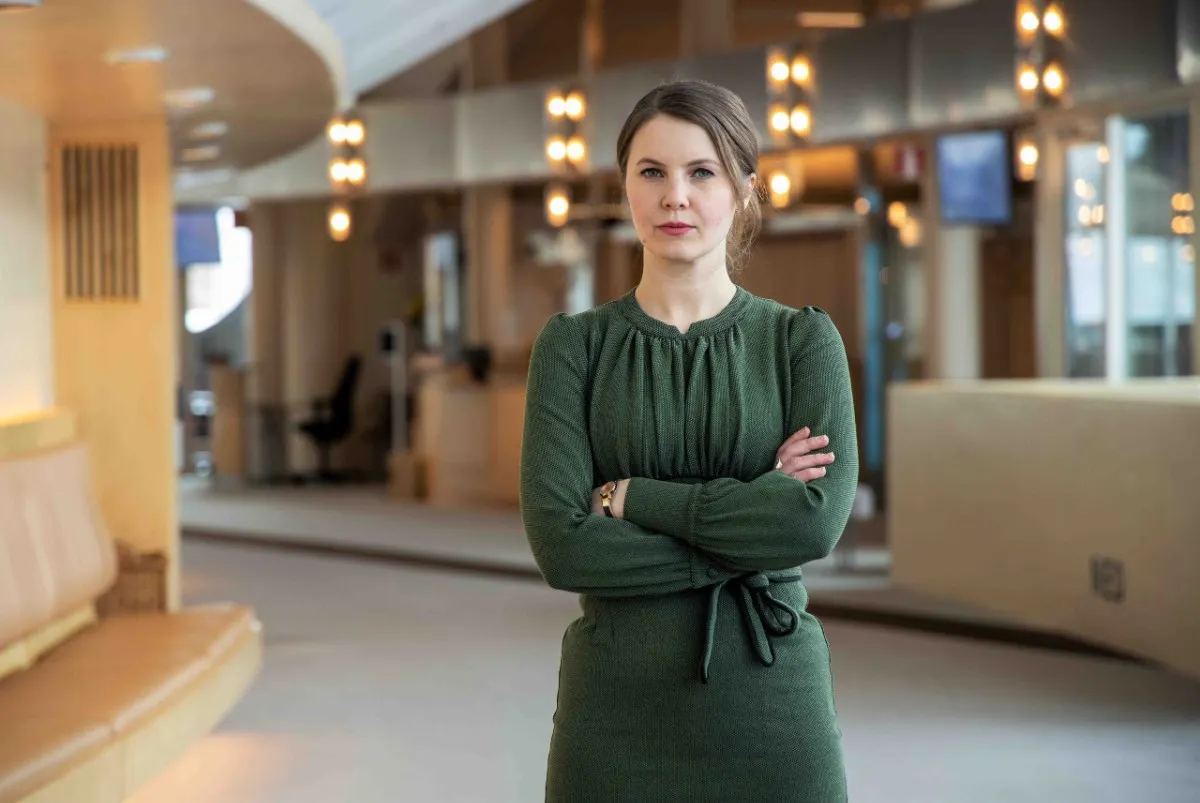
In the third of our interviews with Swedish parties' migration spokespeople, Ida Karkiainen told The Local that the party wanted to find a way to stop people who have lived in Sweden for many years from being deported – whether they are young adults who grew up in Sweden, British citizens, or elderly former asylum seekers.
"This is one thing that we will look into immediately and it will be a question for a fast-track inquiry as well," she said. "We have prioritised this."
She said that Sweden's unusually high refusal rate for British people who applied for post-Brexit residency was "unfair" and "strange", arguing that it had come as "a consequence of migration law as it is right now", and was an issue the party would "be keen on solving if we gain government power".
She said the proposal to make "long establishment" grounds for residency would help young adults and teenagers facing deportation, an issue that generated a media storm in early 2026, but would also apply to many Brexit cases.
"We are saying that we need to look into your long establishment in Sweden and how strongly you are related to Sweden. This should be a situation that can be taken into account."
Karkiainen pointed in particular to cases involving teenagers who have spent most of their lives in Sweden but can receive deportation decisions when they turn 18 or, under the new rules that come into force in October, 21. "A deportation decision when you turn 21 is not fair either," she argued.
The fast-track inquiry, which can be completed in as little as two months, will be launched alongside a longer, in-depth inquiry that will carry out an in-depth reassessment of all the legislation put in place by the new government, with the aim of identifying and removing contradictions and inconsistencies.
READ ALSO:
- 'If you came to work in Sweden because of relaxed citizenship rules, I don't want you'
- Swedish migration minister: 'One day you're a Nazi, the next a left-wing activist'
Strict migration
Despite her criticism of the Tidö government's migration legislation, Karkiainen conceded that the Social Democrats had supported many of the proposals and agreed with the need for a "strict migration policy".
"We have supported some of the suggestions, but a lot of the legislation that has been presented to the parliament more recently has gone too far," she said. "This is not only about adapting to the minimum EU-level; this is legislation that will mean in practice that people are forced to leave Sweden after very many years in the country – so it will be a hard challenge to handle in future."
She warned that the new maintenance requirement for renewing a family reunion permit, in particularly, would split families and lead to deportations.
When the Social Democrats have pledged in this election campaign that "the strict migration policy will remain", this did not extend to deporting people who are already established legally in the country she said.
"It means we need to have a low number of asylum seekers: that is what what stram migrationspolitik means for us. What it doesn't mean is people who are very integrated in Sweden being forced to leave due to new legislation."
READ ALSO: Social Democrats plan huge inquiry to clean up Swedish immigration law
Citizenship rules
Karkiainen confirmed that the Social Democrats planned to restore transitional rules for citizenship applicants who applied before Sweden's new, tougher citizenship requirements came into force on June 6th, but declined to give a precise timetable, saying only that it needed to be done "as fast as possible".
She said on citizenship, the party's main other priority was to reduce the long waiting times, describing the Migration Agency's current official waiting time of 54 months was "unacceptable" and "very hard for a lot of people".
"We don't accept long waiting times like this in other other sectors of society," she pointed out. "When you apply for something from the state or from the municipality, we have this rule in Sweden that says that you should get your your application handled as fast as possible."
The solution, she said, was simply to give the Migration Agency more funding so that it could hire more case officers.
"This is a matter of resources for the Migration Agency. When it comes down to it, they just need more people to handle these applications. That's how simple it is."
The ruling Moderate Party, as of its election pledges, has promised to bring in a fast-track five-year wait for citizenship for foreigners with good jobs, and good behaviour who contribute to society, a suggestion Karkiainen said was frivolous.
"It was only this spring that we voted for the new citizenship rules, and then a few months later the government comes up with this – they could have done this back then," she said.
She was, however, sceptical of the idea of a citizenship fast-track, arguing in principle about rewarding highly paid migrants.
"How do you decide who should go on the fast track? I'm a Social Democrat because I support equality. I like the fact that people cannot buy themselves ahead in the queue."
Temporary replacement for permanent residence
The Social Democrats are also proposing a new type of "establishment residence permit" following the government's removal of the possibility of obtaining permanent residence for many migrants.
Karkiainen described the proposed permit as a "bridge" towards long-term residence and eventually Swedish citizenship.
The permit would be temporary rather than permanent, but could be granted for a longer period than the two- or three-year permits currently used in many cases. The aim, she said, would be to give people greater stability while they work towards citizenship.
Work permits
On labour migration, the Social Democrats want to return Sweden to the system of labour market testing, where unions and employers negotiate over the jobs employers can recruit for internationally and the minimum salaries international hires should receive.
She criticised the system brought in by the current government, where the governing parties are responsible for deciding which occupations should be exempt from the wage requirement, arguing that it takes up too much government time and gives politicians too much power.
Labour market testing could also take regional salary differences into account, ending the current situation where healthcare workers in northern Sweden cannot meet the salary threshold, leading to staff shortages and deportations.
At the same time, Karkiainen stressed that the Social Democrats wanted to ensure that labour migration did not undercut wages.
"We don't want to have any wage dumping in Sweden. We don't want labour migration where you see that the wages are going down for certain groups," she said.
"It's not a good model that the government is applying right now, and this is also a prioritised question that we want to to change if we gain government power."
She said that the government would launch an inquiry into giving the unions back their say over labour migration, but that as this was a return to a system in place before 2008, it would not be difficult to implement.
A loss for Sweden
When The Local told Karkiainen that many readers, primarily highly skilled workers, had told us they were considering leaving Sweden because of the tightening immigration rules, citizenship rules, and the generally harsher rhetoric, she said it was a shame.
"It's a loss for Sweden, because of course we want to attract talent to our country," she said. "Of course, if someone comes and takes a job at a university or something, they don't want their child to end up getting deported."
The "worst part", she said, was the 350,000 kronor re-emigration bonus, which she said sent a clear message that the government wanted foreigners to leave.
"This is a direct consequence of the signals that this government has been pushing out for years now – that people aren't welcome to Sweden."
A future migration minister?
With only a week to go until the election and uncertainty about which constellation of parties will make up a future government, even if the left-bloc wins, Karkianen said she had "no idea" which party would appoint Sweden's next migration minister.
"But whoever it will be, that person will have a really difficult policy area to handle over the coming four years. Whoever it is, they will need to work very hard."