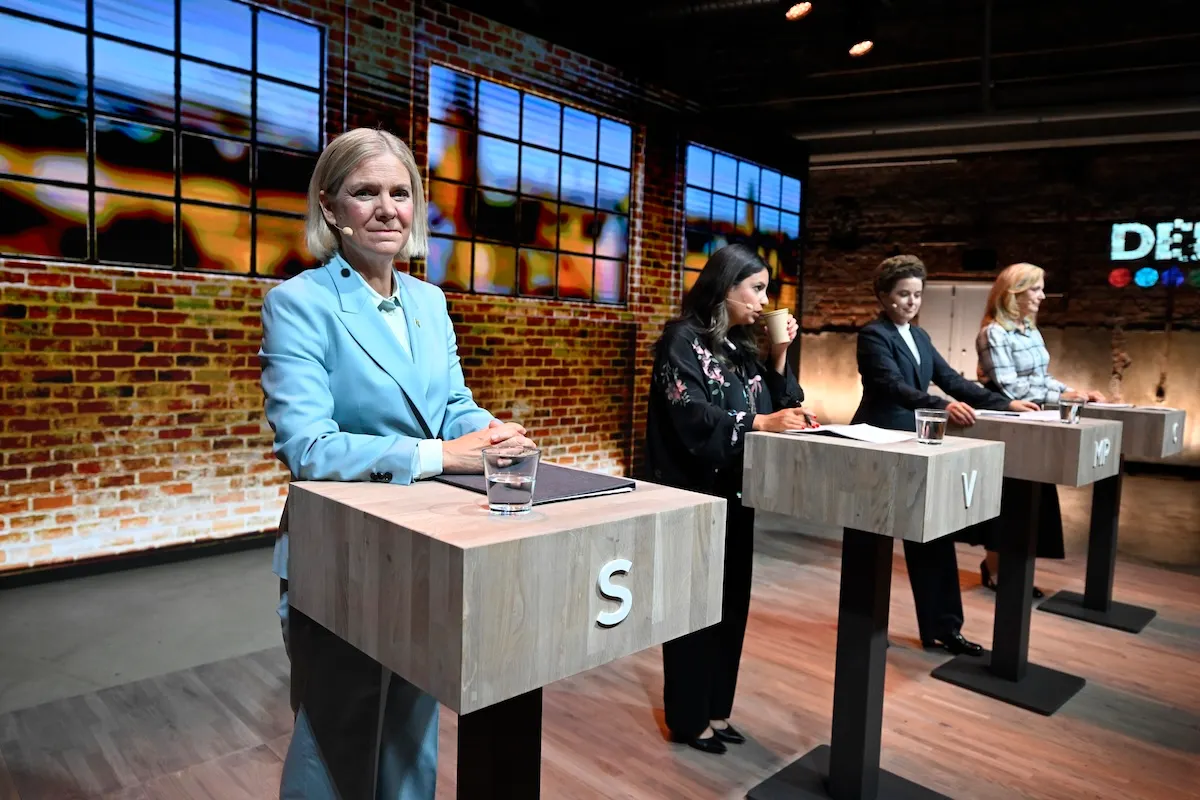
A poll by Indikator Opinion for Swedish public broadcaster Sveriges Radio (SR) published on September 4th confirmed that the opposition Social Democrats were on track to receive their worst election result in over 100 years, losing votes mainly to the Left, Green and Centre parties but also across the left-right bloc.
The party's support has dropped a dramatic 3.4 percentage points from the last Indikator poll in late August to 27.9 percent, the lowest result the party has ever received in a poll by the company.
The poll confirmed the finding of another shock poll from Novus published on Tuesday, which showed the opposition's lead on the Tidö parties had fallen to just 2.6 percent from 9.6 percent in June, after the Social Democrats fell 4.3 percentage points in just a month to 25.8 percent.
In an interview with The Local, the Social Democrats' migration spokesperson Ida Karkiainen said she believed that the Centre Party's call for a centrist government including the Christian Democrats and its refusal to back a government that includes the Left Party was pushing voters who would otherwise vote Social Democrat to vote either for the Centre Party or the Left Party, to increase the likelihood of their preferred government.
"Maybe you want to vote for the Social Democratic Party, but you want us to go to the left, and therefore you vote for the Left Party, or you want us to go to the right, and therefore you vote for the Centre Party. It feels like we are being squeezed a bit in the middle," she said.
The opposition's shrinking lead has made a government consisting of only the Social Democrats, the Green Party and the Left Party – which had its own majority in some polls back in the spring – look increasingly impossible.
The Indikator poll puts this combination 14 seats short of a majority.
But it is still more likely than the coalition favoured by the Centre Party and by the right-wing of the Social Democrat party, which is 21 seats short of a majority according to the Indikator poll.
This means that if the election mirrors the Indikator poll, the Social Democrats' leader Magdalena Andersson will only be able to form a government if she can either convince the Centre Party to accept a government that includes the Left Party, convince the Left Party to support a government which it is not, itself, a part of, or else form a government with one of the current government parties, most likely the Christian Democrats.
The centrist government option
Centre Party leader Elisabeth Thand Ringqvist said earlier this month that she wants to form a four party centrist government with the Christian Democrats.
This coalition would have a four-seat majority in the Indikator poll.
The Green Party, however, have ruled out sharing a government with the Christian Democrats, as they argue that the party's leader Ebba Busch has taken a wrecking ball to Sweden's environment policy in her four years as Energy and Business minister.
Busch, meanwhile, has said she would be willing to let Sweden have a new election before she would be willing to join or support such a government.
If the Centre Party can be convinced to join a government that includes the Left Party, this would have a solid 14-seat majority. At present, however, the party shows no signs of backing down from its refusal to support a government with Left Party ministers.
Similarly, if the Left Party agreed to support a Social Democrat-led government without having its own ministers, this would allow Magdalena Andersson to be voted in as prime minister by a 14-seat majority.
The resulting coalition government would then be 20 seats short of a majority, requiring support from the Left Party or from one of the current government parties to pass legislation.
The Left Party is also showing few signs of backing down from its demand for government ministers, however, although the party's leader Nooshi Dadgostar has expressed confidence that the contradictory positions of her party and those of the Centre Party can be resolved without a new election.
Another option for the left-wing bloc would be a minority government of the Social Democrats dependent on the support of one or more parties.
This would also allow Magdalena Andersson to be voted in as prime minister by a 14 vote majority. The resulting government, however, would then be a challenging 72 seats short of a majority, meaning it might end up having to piece together temporary coalitions for each parliamentary vote.
Make your own government with The Local's widget