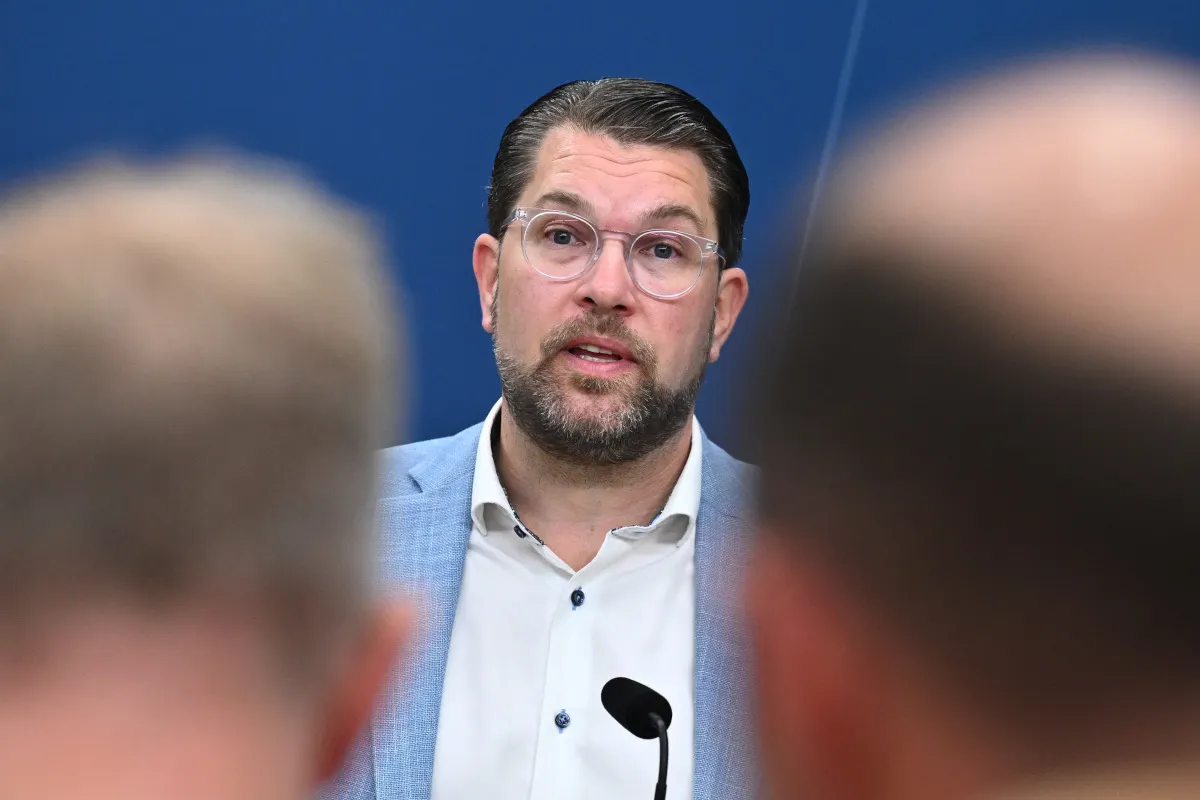
Swedish PM says no room for pro-Russian narratives after SD official linked to pro-Kremlin posts
A Sweden Democrat official accused of spreading pro-Russian information must be fired in the allegations are true, Prime Minister Ulf Kristersson told the Aftonbladet newspaper.
According to an investigation by anti-racism magazine Expo, the official – a woman who moved from Russia to Sweden in 2006 – shared articles and posts featuring Russian narratives between 2015 and 2017. These came from Russian state bodies, state-controlled outlet RT, and other channels known for Russian propaganda and disinformation.
She previously shared a tribute song to Russian President Vladimir Putin on social media, complete with heart emojis and the caption "people singing about their love for the president". According to Expo, the woman – who lives with one of the Sweden Democrats' top officials in the government offices and architects of the Tidö government coalition agreement – continued to share pro-Russian content as recently as 2024 and 2025.
Kristersson said there is no space for pro-Russian narratives in Sweden.
"We are in the middle of a European war. This is serious business," he told Aftonbladet. "You simply cannot have people sitting around spreading pro-Russian narratives while working in Sweden's parliament."
Sweden Democrat leader Jimmie Åkesson said the party had "no knowledge" of the situation. He stressed that the official is currently off work and will remain so for some time.
"This isn't something the party had any knowledge of, as far as I know. It's something that came to light today, but we'll have to look into it and get to the bottom of it. We have time," he told public broadcaster SVT.
"I see no reason to panic about this," he added.
Earlier, his far-right party's press office said in an email to the TT news agency that the individual has "publicly been strongly critical of the Russian regime in recent years" and is currently on parental leave.
Teresa Carvalho, justice spokesperson for the centre-left Social Democrats, described the allegations as a "security crisis" until "proven otherwise."
"In the worst-case scenario, this is a serious infiltration attempt by a foreign power right into the core of Swedish power," Carvalho told a press conference, urging the prime minister to get to the bottom of what happened and clarify whether his office was aware of the relationship between the woman and the senior official. "The Swedish public deserves answers," she added. (TT/The Local)
Swedish vocabulary: allegations – anklagelser
Danske Bank delays expected Riksbank interest rate hike to November
Danske Bank still expects two interest rate hikes from Sweden's central bank, the Riksbank, between now and 2027. However, it has pushed back its forecast for the first hike to November this year.
"These are the best times for households," said the bank's chief economist, Susanne Spector.
The Riksbank's next interest rate decision will be announced later in September. Even though Danske Bank expects a rate rise in November, Spector believes there is actually no reason for the bank to wait.
"The economy is already back to normal, inflation risks are growing, and monetary policy operates with a lag. But given how the Riksbank communicated in August, we think it will take one more meeting."
After that, Danske Bank expects another hike in February next year, which would bring the policy rate to 2.25 percent.
DON'T MISS: The Local Games – find the Swedish word in WordroW and crack the daily sudoku
Spector does not believe two rate hikes will put too much strain on Swedish households.
"If you look at household interest rate expectations in the National Institute of Economic Research's barometer, you can see that households are already expecting higher rates," she said.
"It appears that households have both adapted to the current rate environment and accepted that the next step will be a couple of hikes."
At the same time, Spector points out that inflation will be higher next year, as will interest rates. Inflation according to the CPIF measure – which fixed-rate mortgages are excluded from – is expected to rise to 1.4 percent this year and 2.7 percent next year, according to the bank's latest forecast. The bank has also raised its GDP forecast for 2026 from 2.1 percent to 2.8 percent, alongside a slight upward revision for 2027 (from 2.4 to 2.5 percent). (TT/The Local)
Swedish vocabulary: policy rate – styrränta
Ryanair signs collective agreement for Arlanda cabin crew
Budget airline Ryanair has signed a collective bargaining agreement with the Swedish Transport Workers' Union.
The deal covers Ryanair's base at Stockholm Arlanda Airport, meaning cabin staff will now receive union-agreed wages and employment terms, the union stated in a press release.
"This is a historic announcement for Ryanair's employees and an important success for the Swedish model. Since Transport took over the agreement area, the goal has been clear: Ryanair's cabin crew in Sweden must have collective agreements, secure conditions and the opportunity to influence their work situation. Now we are there," Tommy Wreeth, chairman of the Transport Workers' Union said in a statement.
"For Transport, the agreement is also important in principle. All companies operating in the Swedish labour market must respect the Swedish model, where wages and working conditions are regulated through collective agreements between the social partners," he said.
"No one should have to compete with worse wages and conditions. When such a large European airline operator as Ryanair signs a collective agreement in Sweden, it is a success for our members, but also for the entire Swedish model."
Ryanair's chief people officer, Darrell Hughes, said the agreement followed months of intensive negotiations.
"This agreement will support Ryanair's $800 million investment in Sweden and helps secure well-paid, highly skilled aviation employment. Following the abolition of the harmful Aviation Tax from Jul 2025, Sweden needs to continue to lower access costs so it can remain competitive and secure air connectivity, which the next government should prioritise to allow Ryanair to continue to invest and create jobs in Sweden as we to grow to carry 300 million passengers per annum by 2034." (The Local)
Swedish vocabulary: collective bargaining agreement – kollektivavtal
How much more will your electricity bill cost in Sweden this winter?
Residents in southern Sweden can expect to pay around 700 kronor more per month for their electricity this winter compared to last year. Further north, cost increases will be more modest, provided forecasts hold true.
There is no energy crisis expected, but power will be significantly more expensive than last winter – a warning analysts have sounded repeatedly. The decisive drivers are lower-than-normal water levels in reservoirs, alongside skyrocketing gas prices making electricity more expensive on the continent, which directly impacts the southern half of Sweden in particular.
Electricity prices are already at higher levels than last year. Autumn is unlikely to offer much relief either, as half of Sweden's nuclear fleet will periodically be taken offline for annual maintenance.
The real blow is expected this winter, according to forward pricing on electricity, just as consumption typically rises.
Based on these projections, energy supplier God El has calculated monthly costs for standard households between December and February. In southernmost Sweden (bidding area 4), the power bill – excluding grid fees and tax – for a detached homeowner is expected to land around 3,700 kronor a month. That is 700 kronor higher per month than last winter, adding up to several thousand kronor extra across the colder months.
During the energy crisis winter of 2022-2023, monthly costs stood at roughly 4,800 kronor, though substantial state energy subsidies were paid out at the time.
In bidding area 3, which covers Svealand and northern Götaland (so if you live in Stockholm or Gothenburg, among other places), bills are projected to hit roughly 3,100 kronor a month – an increase of 300 kronor. In northern Sweden (bidding areas 1 and 2), costs are set to rise by 300 kronor to reach 2,100 kronor.
On top of the raw power cost, an owner of a detached house consuming roughly 20,000 kWh annually must add nearly 2,000 kronor per month on average for grid fees and energy tax – a charge independent of the spot price. However, since energy consumption spikes during winter months, the total bill will end up substantially higher.
For apartment dwellers, the sums are significantly lower. Nevertheless, the general advice is to prepare in advance for what lies ahead. (TT/The Local)
Swedish vocabulary: bidding area – elområde (Sweden is divided into four pricing areas, SE1 to SE4, where power prices vary based on regional supply and transmission capacity)