Quick facts
Party name in Swedish: Socialdemokraterna, Sveriges socialdemokratiska arbetareparti (sometimes, colloquially, sossarna)
Leader: Magdalena Andersson
Current number of seats in parliament: 106 (was 107 after '22 election)
Vote share in the last election (2022): 30.3 percent
Part of the current governing coalition?: No
Current ministerial posts: None
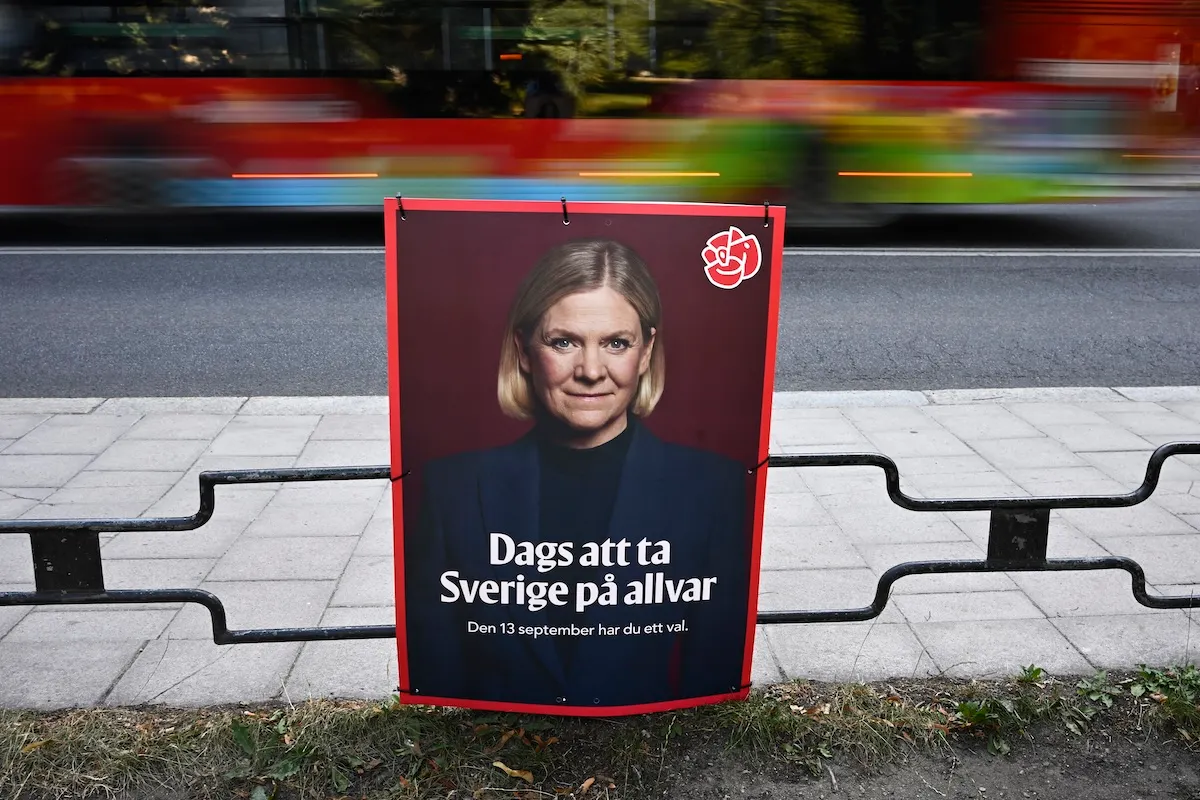
2026 election slogan: Det är dags att ta Sverige på allvar – It's time to take Sweden seriously
Party background
The Social Democratic Party is Sweden's oldest political party. It was founded in 1889 by representatives of the labour movement, including 70 trade unions, to promote the movement's interests in parliament.
In its early days, the party fought for universal suffrage, an eight-hour working day, and the right to unionise.
August Palm, the socialist firebrand who was one of the leading figures in the party's early years, soon gave way to the more moderate Hjalmar Branting, the middle-class son of a university professor, who became the first Social Democrat Prime Minister in 1920.
In 1932, with the election of Per Albin Hansson, the party began a 40-year period of rule – sometimes as a minority government and sometimes with the support of the forerunner of today's Centre Party – during which time it built the foundations of Sweden's welfare state.
Throughout this period, Sweden was part of the non-aligned movement, and Olof Palme, who became prime minister in 1969, drove an activist foreign policy, criticising the US war in Vietnam, apartheid in South Africa, and authoritarian regimes such as those of Spain and Chile, but also that of the Soviet Union.
Palme's assassination in 1986 marked a turning point for the party. The severe financial crisis that roiled Sweden four years then compounded its difficulties.
In the wake of the crisis, the opposition won the 1991 election, with Carl Bildt becoming the first Moderate Party prime minister since 1930. The Social Democrat leader Ingvar Carlsson won power back in the 1994 election, resigning in 1996 to let Göran Persson take over.
Persson served as prime minister for ten years, a period of austerity in which he cut public spending and made significant reforms to welfare spending.
After Persson lost the 2006 election, the party was then out of power for two terms, with his successor Mona Sahlin losing the 2010 election. Her resignation threw the party into even deeper crisis. Her successor, Håkan Juholt, was forced to resign after less than a year in what some have described as an internal coup.
Juholt's successor, the dependable if stolid union leader Stefan Löfven, finally brought the party back to power after the 2014 election in coalition with the Green Party, although he lacked a majority and so depended on the December Agreement, under which the Moderate, Liberal, Centre and Christian Democrat parties agreed to let him take office as prime minister and pass budgets.
Löfven took power again without a majority after the 2018 election, this time with the support of the Centre Party and Liberal Party in the January Agreement. Under this far-reaching agreement, Löfven's government pushed through tax cuts and other right-wing policies as the price of power.
Löfven resigned in June 2021 after the Left Party withdrew its support for the government over rent control reform, and joined the right-wing parties in a no-confidence vote. He was then voted back in on July 7th and led Sweden until November, when he made way for Magdalena Andersson as Sweden's first female prime minister.
Key priorities in the 2026 election
The party has a long-standing reputation in Sweden for prioritising power above all else, and there is probably some truth in the idea that its overriding goal in this election is to return Magdalena Andersson to the premiership.
It has not forgiven the Left Party for unseating Löfven and has a long-term goal of splitting the centre-right bloc. So it would arguably prefer to share government with the Centre Party rather than the Left Party, and would ideally want to avoid giving the latter ministerial positions.
The Social Democrats have shifted to the right on immigration and crime in this election in a clear attempt to win back blue-collar voters from the populist Sweden Democrats. Party officials will be watching carefully to see if this strategy succeeds.
What are their positions on key issues?
The party is once again campaigning on the personality of Magdalena Andersson, and has issued very few concrete policy pledges, perhaps to make it easier in post-election negotiations.
Immigration
The party congress in 2025 voted that the party should push for "strict migration policies that are sustainable in the long term".
Its key pledge in the election campaign is that Sweden's strict migration policy – presumably meaning that brought in by the Tidö government – will "remain in place". The party argues that this is necessary "to keep Sweden together and manage the integration of those who have already arrived". Like the government parties, it wants Sweden's migration policy to be set at the minimum level of generosity allowable under EU law.
That said, the party plans to roll back quite a few Tidö policies.
It wants to bring back permanent residency for asylum-related cases, which the Tidö government phased out, by launching a new etableringstillstånd, a residence permit aimed at facilitating integration/establishment. This is like the old permanent residency, with the only difference being that applicants will need to meet language and civics knowledge requirements.
It wants to replace the salary-threshold-based work permit system brought in by the current government with a system of so-called "labour market testing", in which unions and employers would negotiate over which job types employers can recruit internationally.
Party leader Magdalena Andersson has also said the party will add transitional arrangements to the new citizenship rules if elected.
The party wants to strip asylum seekers of their right to arrange their own accommodation and increase efforts to deport those denied asylum.
It wants to cut processing times at the Migration Agency, particularly for citizenship cases.
Finally, it wants to abolish Sweden's utsatta områden, or specially vulnerable areas of cities, although it is increasingly vague about how.
The economy (including cost-of-living and taxes)
The party's economic policy is a mixed bag of left-leaning and right-leaning policies.
It wants to levy a temporary tax on banks' excess profits to generate money to boost welfare spending. It has pledged to increase child benefit, the study benefit paid to upper secondary school students, and housing benefit, although it has given no detailed numbers on this.
On the right, it wants to make the first 300,000 kronor saved in an individual savings account, or ISK, tax free.
The party has also promised to double child benefit in the months before Christmas and the summer holidays.
Healthcare
It wants to change primary care so that everyone has their own personal doctor at their local primary care centre. It also wants to limit profit-making in healthcare and crack down on companies providing poor-quality care.
The party on September 1st promised to expand the recently introduced enhanced high-cost protection for dental care, where the patient only pays 10 percent of the reference price for most treatments, so that it covers all adults, more or less exactly copying the Sweden Democrats.
The party had previously promised to improve high-cost protection for dental care, restore free dental care for people under 23 and increase subsidies for people under 29.
Climate
Meeting Sweden's climate goals, the party admits, will be "an uphill struggle", after what it calls the "four lost years" under the current government, but it says it will do everything in its power to do so.
It has pledged, however, not to reverse the current government's tax cuts on petrol and diesel or to increase the biofuels obligation. Instead, it wants the state to buy large quantities of biofuels manufactured in Sweden, which can then be added to the fuel mix without raising prices at the pump, calling this mix Sverigebränslet, or Sweden fuels.
The party is pledging to speed up the development of wind power, especially offshore, and to expand nuclear power in Sweden.
Crime, security and defence
The party wants to bring in a so-called "mafia law" that will make it easier to jail gang leaders for crimes committed by their underlings, and take earlier, more decisive action to stop children and youths being drawn into crime.
It wants to scrap sentence reductions for multiple offences for sexual offences such as rapes, and scrap sentence reductions for other serious offences when prison places are available.
Education
The party wants to stop private companies that operate schools from taking profits, ban religious free schools, and impose stricter requirements on other free schools.
It says it wants smaller classes, more teachers, better access to higher education across the country, better vocational training, and more money to non-formal adult education, or folkbildning, but does not provide any concrete figures or targets for any of this.
Which of the other parties will they work with?
Magdalena Andersson claims to be willing to work with any party except the Sweden Democrats. The party could either push for a one-party minority government, or a majority government. Depending on the election result, it could seek to form a government with some combination of the Green, Left and Centre parties, and potentially the Christian Democrats.
The party's big headache is the Centre Party's refusal to support or join a government that includes Left Party ministers, and the Left Party's refusal to support a government that does not include Left Party ministers.
The party leadership would almost certainly prefer a one-party government and seek support from various parties on various issues, but if it can't have that, it would probably prefer a coalition that includes the Centre Party and either has the Left Party as a support party or excludes it entirely. But if it can form a majority government with the Green Party and the Left Party alone and no other coalition were possible, it would probably do so.
What are its chances?
Statistics Sweden's May party preference survey, which is widely seen as the most reliable estimate of voter opinion, estimated the party's support among voters at 33.9 percent, more than three percentage points above its result in the 2022 election.
But the party's support in the polls has been ebbing away since hitting a peak of above 38 percent in mid-2023. Since the launch of the election campaign, this process has accelerated, with recent polls bringing it closer to 30 percent.
As most of these voters are moving to the Left, Green and Centre parties, however, the opposition still has a solid, albeit shrinking, lead on the pro-government parties, although this has shrunk from 8 percentage points to closer to 5 percentage points. If, as seems likely, the Liberal Party fail to enter parliament, however, this still translates into a solid 27-seat majority.
It still looks likely that Magdalena Andersson will win a second term as prime minister, but it's looking less and less certain by the day.
This is the eighth and final article in a series taking a deep dive into the eight Swedish parties' election platforms. We've based the series on the issues The Local's readers told us in a survey earlier in 2026 that you were interested in. The last party guide was on the Sweden Democrats.
Keep following The Local to stay on top of the Swedish election.