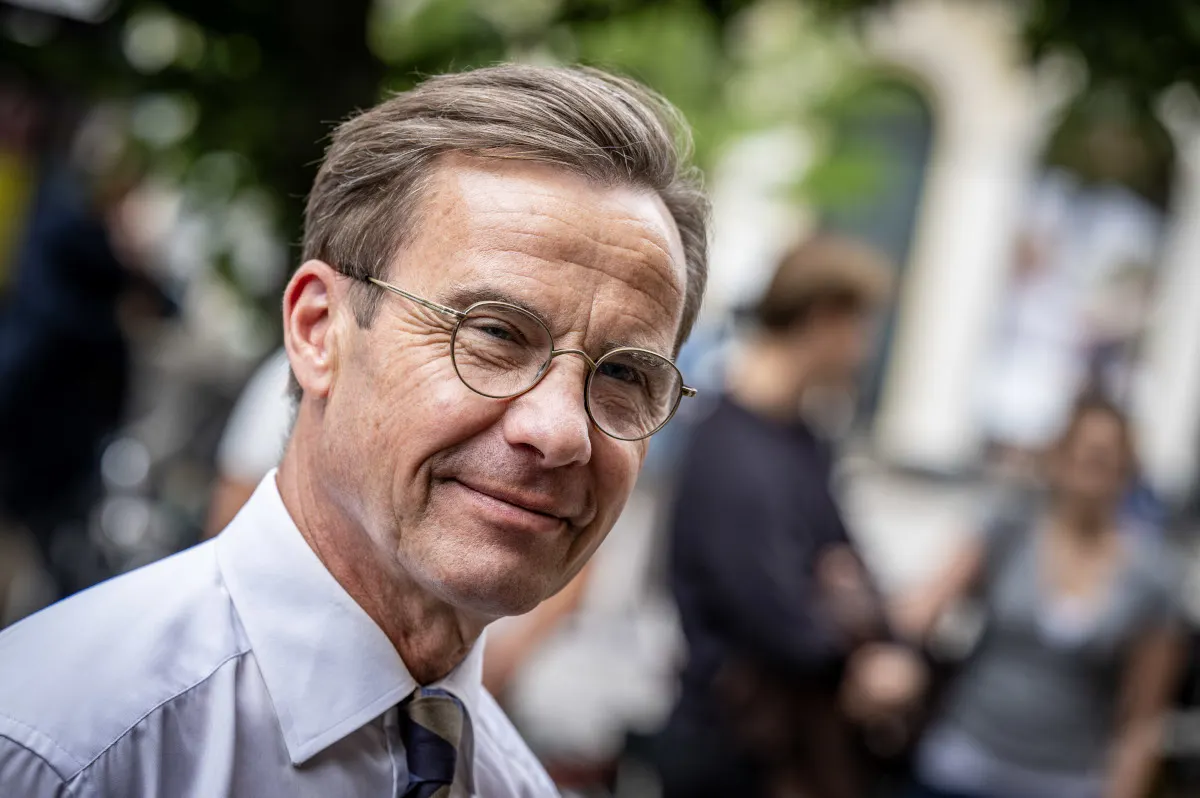
Quick facts
Party name in Swedish: Moderaterna
Leader: Ulf Kristersson
Current number of seats in parliament: 66 (was 68 after '22 election)
Vote share in the last election (2022): 19.10 percent
Part of the current governing coalition?: Yes.
Current ministerial posts: Prime Minister (Ulf Kristersson), Justice Minister (Gunnar Strömmer), Immigration Minister (Johan Forssell), Finance Minister (Elisabeth Svantesson), Defence Minister (Pål Jonson), Civil Defence Minister (Carl-Oskar Bohlin), EU Minister (Jessica Rosencrantz), Foreign Affairs Minister (Maria Malmer Stenergard), and more.
2026 election slogan: För ett rättvisare Sverige ("For a fairer Sweden")
Party background
The party was founded as Allmänna valmansförbundet (The General Election League) in 1904 to combat “the ongoing efforts of social democracy and the radical left to disintegrate [society]", and was initially founded by the leader of the employers' association, Gustaf Fredrik Östberg, together with other factory owners and landowners.
In 1938, it rebranded itself as Högerpartiet (The Right-wing Party), before settling on Moderata samlingspartiet (The Moderate Coalition Party) in 1969. In 2006, the party's leader, Fredrik Reinfeldt, rebranded it Nya Moderaterna (The New Moderates) to signal a shift towards the centre. The party has since reverted to Moderaterna.
The Moderate Party led the country for three terms between 1912 and 1935, before being relegated to the opposition during the Social Democrats' 40-year period of hegemony between 1936 and 1976. During the right-wing coalitions of 1976 to 1982, Moderate ministers served under Centre Party and Liberal Party prime ministers.
So it was historic when Carl Bildt in 1991 became the party's first prime minister since 1936. The party led once again for two terms between 2006 and 2014, after Reinfeldt formed the Alliance with the four other right-wing parties.
Ulf Kristersson then took the party back to the right, taking power in 2022 with the support of the far-right Sweden Democrats.
The three-party coalition and its support party are commonly referred to as the Tidö Government (Tidöregeringen) named after Tidö Slott, the country mansion where the coalition deal was done.
Key priorities in the 2026 election
The party's goal is for Sweden to be the EU's richest country within ten years. It wants to give the average working family tax breaks and benefits so they have an extra 5,000 kronor to spend a month. It also wants more foreign criminals to be deported, and the end of sentence reductions for multiple offences.
From a party standpoint, its priority is simply to regain power by ensuring that the Tidö coalition once again gets a majority. It will be seen as a success if it increases its vote share above the 19.10 percent it won in the 2022 election, particularly if it overtakes the Sweden Democrats to become the biggest party on the right.
What are their positions on key issues?
We have based the following sections on the issues The Local's readers told us in a survey earlier in 2026 that you were interested in.
Immigration and integration
The party wants to ensure that Sweden has the strictest rules for asylum-related immigration allowable under EU law, with only "minimal" asylum-related immigration. It also wants to push the EU to tighten its own migration policies and to reform EU migration laws to reduce asylum migration to a minimum.
At the same time the party wants to make it easier for companies to recruit highly skilled workers internationally, with the possibility of exceptions to the salary threshold for work permits for jobs where there is a labour shortage.
The party has four concrete election pledges:
- a fast track to Swedish citizenship for foreigners who work, are well-integrated and "gör rätt för sig" (meaning something like "pull their weight" or "contribute their fair share")
- to change the law so that men who are convicted of domestic violence (våld i nära relation) are barred from Swedish citizenship
- to set up a "Sweden Contract" or Sverigekontrakt, which all foreigners need to sign, the breaking of which will be grounds for losing a residency permit
- that unemployed foreigners will be expected to look for work across the entire country and not only where they live
The economy (including cost-of-living and taxes)
Traditionally the Moderates' focus has been on the economy and particularly on cutting taxes.
In this election, the party is promising to make the government and government agencies more efficient by appointing a slöserikommission or "wasteful spending commission", which would identify wasteful spending in the state sector and propose ways to eliminate it.
The party aims to cut taxes for employed people and pensioners by up to 1,000 kronor a month, make public transport tax free for commuters, and, they claim, in total cut taxes for the average family with children by an additional 5,000 kronor a month.
It also wants to change income tax at the state level (so for those who earn more than 55,033 kronor a month) so that no one pays more than 50 percent of their salary in total tax. This would save someone earning 3.6 million kronor a year as much as 170,000 kronor in tax.
The party wants to cut corporate tax so that Sweden has "one of the EU's most competitive corporate tax rates", and cut employer social security contributions.
It wants to raise the tax threshold on Swedish Investment Savings Accounts (ISK) to 500,000 kronor.
Healthcare
The party wants to shorten the "healthcare guarantee" from 90 to 30 days (the maximum time patients should have to wait to see a specialist doctor), and increase the compensation liability for regional health authorities who fail to live up to this goal.
Beyond this, it has five clear new pledges:
- to increase the age at which people can be treated in child psychiatry units, or barn- och ungdomspsykiatrin (BUP) from 18 to 21
- to look into offering more subsidised IVF treatment
- to give women a greater role in planning the birth of their children
- to bring in a new programme for aftercare
- to assess the treatment of endometriosis and establish new national guidelines on menstrual health and period pain in school health units
Climate
The Moderate Party continues to back Sweden's target of achieving net zero emissions by 2045, and wants to do this through climate action that has the greatest possible impact on emissions for the smallest possible cost.
It wants to build nuclear power reactors in southern Sweden so that the country's hydropower production can be used to support green industry in the north.
The party also wants to export climate-smart technology to reduce emissions in major emitters like China, India and the US.
Crime, security and defence
The party claims that their criminal justice policy is focused on putting the victim first, and aiming to ensure that crime has "tangible consequences". It is "criminals and not law-abiding citizens who should be worried," it writes on its website.
The party wants to:
- push ahead with abolishing sentence rebates for multiple offences (the law was passed in August but no date was given for implementation)
- double compensation for victims of crime and strengthen the victim's position in the legal process
- establish a confiscation fund where criminal profits are returned to crime victims and crime prevention work
- strengthen the municipalities' security work with municipal security guards and expanded local powers
- strengthen the right to self-defence for those who are subjected to unprovoked attacks, especially in their own homes
Education
The party claims to want to bring back "knowledge schools" where effort is rewarded, expectations are high, and skilled teachers give children the opportunity to build their own lives.
As part of that it wants all primary school teachers to be given courses in "evidence-based reading instruction", with a special focus on the decoding method, and it also wants Sweden to draw inspiration from the successful "No Excuses" school model, with its focus on discipline.
The party wants to cut back on special provisions in schools for students with foreign backgrounds, pledging to abolish Swedish as a second language and replace it with basic language education with grades that are not merit-based.
It also wants to reform Sweden's system of modersmålsundervisning, or "mother tongue tuition", so that there are "clearer rules for which students should have the right to it", requirements for licensed teachers and more distance learning.
It wants to bring in language and aptitude tests for employment in preschools and schools, and develop a transition programme for staff with inadequate language skills.
It has also pledged to abolish the payments parents have to make for preschools and after-school care.
It has also pledged to change student loan and grant rules so that students can get a summer job and still receive their payments.
Which of the other parties will they work with?
The Moderates are aiming form a new government coalition with the Sweden Democrats, Christian Democrats and Liberal Party, which will be led by the party's leader Ulf Kristersson as Prime Minister.
If neither side manages to win a majority or parties in the left bloc fail to overcome their differences, there is a also chance that the Centre Party could be brought into a right-wing coalition. It is very unlikely that the Moderates would support a government led by Social Democrat leader Magdalena Andersson, or join a coalition with the Left Party, or Green Party.
What are their chances?
The May poll by Statistics Sweden, which is widely seen as the most reliable estimate of voter opinion, estimated the party's support among voters at 17.3 percent, a slide of nearly two percentage points on the 2022 election result. This poll also gave the opposition parties a hefty 15.6 percentage point lead on the Moderate-led bloc.
But as the election campaign kicked into gear, polls are showing the Moderates' support rising (to 18.9 percent in a recent poll by Ipsos) and the Tidö bloc closing the gap (to just 4.7 percent in the Ipsos poll). It still looks unlikely Ulf Kristersson will win another term as prime minister, but it's getting harder to absolutely rule it out.
This is the sixth article in a series taking a deep dive into the eight Swedish parties' election platforms. We've based the series on the issues The Local's readers told us in a survey earlier in 2026 that you were interested in. The previous party guide article was on The Centre Party.
Keep following The Local to stay on top of the Swedish election.