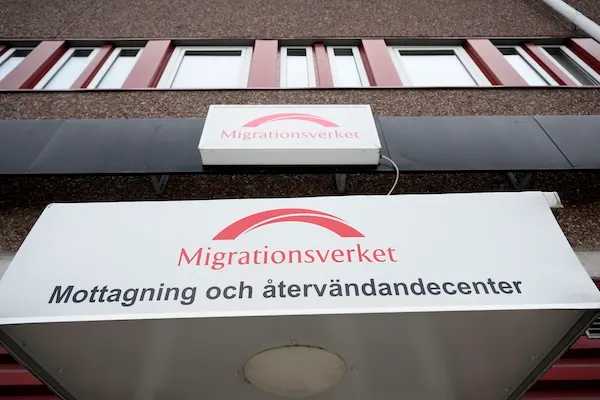
Sweden has deported more of its British residents after Brexit than any other EU country, including people with dementia and people who came to Sweden as children. This has led to criticism that the country was breaching the spirit – and possibly the letter – of the Brexit deal between the UK and the EU. But the country’s migration agency, Migrationsverket, insists to The Local that it has followed all the rules.
The Withdrawal Agreement, under which Britain left the EU, was intended to protect the rights of British people living in the EU, giving them the legal right to stay in the EU country they lived in. Implementation was left up to individual countries.
While most countries let Brits stay — on average only 4 percent of applications were rejected across the EU – Sweden is an apparent exception. Fully 27.5 percent of applications from British citizens were rejected by the Swedish authorities. Sweden accounts for roughly one-third of all deportation or removal orders issued to British nationals across the entire EU post-Brexit, according to statistics from the UK-EU committee on citizens' rights.
But Jesper Tengroth, head of press at the Migration Agency, claims that even though EU member states have common standards on collection of statistics, the figures still don’t represent the truth:
"You can't compare the statistics side by side like that across countries — different countries interpret the statistics differently, or compile their own statistics in different ways,” he told The Local in an interview.
"I think we have fairly good statistics in Sweden, but Sweden counts one way, the Netherlands counts another way, Finland a third way. So that's the problem — it becomes apples and oranges."
He insists that, whatever the truth of the statistics, Sweden has followed the EU rules:
"We can't see, having gone through our cases, that we have interpreted the withdrawal agreement in an extreme or different way compared to other member states,” he said.
Yet there is no doubt that British citizens who lived in Sweden for years, sometimes decades, have been told to leave Sweden after Brexit. Many of these are vulnerable people, such as George Mason, who requires 24-hour care for Alzheimer’s. Others are entirely integrated in Sweden, like Nichola Stanlick, who moved here in 1984 at the age of seven.
Similar stories from other EU countries are rare.
Of those forced to leave Sweden, or who still face being thrown out, many were refused permits because they applied after the deadline. Unlike some other countries, Sweden did not automatically provide Brits with a new status, nor did it contact British citizens individually to inform them about the process, relying instead on media campaigns.
Tengroth argues that British people living in Sweden should have been proactive:
"Brexit can hardly have come as a surprise to the European population as a whole, and especially not to British citizens... there is a personal responsibility here to find out what applies to you.”
Neither The Local or campaign group Brits in Sweden has identified any cases of late applications being granted. While Tengroth insists that some have been allowed, he couldn’t immediately provide evidence for this. The agency’s website stresses that late applications will be considered, but only in exceptional cases. Not knowing that you had to apply — for instance because you were already in the population register or because you hadn’t been informed — is not a good enough reason, according to the agency.
Some Brits denied the right to stay — perhaps a majority — applied on time, but were refused for not meeting the criteria for EU residency. Nichola Stanlick was one of these. She had lived in Sweden over forty years, but was between jobs at the time she applied, having quit her previous employment. The Local has a power of attorney from Nichola to ask Tengroth about her case.
Crucially, the Withdrawal Agreement states that refusal to grant a residence permit may not be “disproportionate”. According to the EU’s directive on free movement of people, a decision on proportionality should take into account how well-integrated the person is, how long they’ve lived in the country, their age, state of health, family and economic situation and the links with their country of origin.
Nichola Stanlick appears to tick most of the boxes — she’s well-integrated, has family in Sweden, and has weak links with the UK. Yet Tengroth insists that the decision to refuse her application was proportionate because she had quit her job:
"Under EU law you only keep your right of residence if you become involuntarily unemployed — for example through redundancy. She chose to resign on her own initiative, and in that case the right of residence ends immediately under the rules,” Tengroth said.
One loophole in the Swedish law that looked helpful to some of those affected was a clause in Swedish national migration law that allows officials to make exceptions to strict residency requirements in “'exceptionally distressing circumstances.” But the bar for this is high, says Tengroth.
“Swedish legislation says that to stay in Sweden if you're ill, you have to be so ill that you are at the end of your life — you might have weeks left to live, or days left to live.”
"That you have family here, or that you're just seriously ill — that's not enough. You have to be close to death, or the care you need has to not be available in your home country. And I think we can agree that the care available in Sweden is also available in the UK.”
The Migration Agency and the Swedish government have maintained a strict approach throughout the Brexit process, but Tengroth insists it has been a reasonable one:
"It's not as if we'd sat around during a coffee break and decided, 'well, here at the Migration Agency, we're going to be tougher than every other country.' That's not how it is. We follow the rules — it's our job to follow the regulations that parliament has decided on, and in this case the agreement between the EU and the UK. We follow those rules."
But there are signs that things might be shifting. Johan Forssell told Dagens Nyheter this week that the government in principle wants British citizens to be able to extend their residency and stay in Sweden.
"We are therefore going to look at the issue and see if we can do something from our side to ease the processes.” Similar promises were made by Forssell’s predecessor Maria Malmer Stenergard in 2023. But Tengroth said that while a review could happen, the Migration Agency was confident it had acted correctly:
“It's clear that we're always thinking about how we've handled different things, but so far we've felt very confident in the way we've handled these cases.”
Interview by Richard Orange, text by James Savage