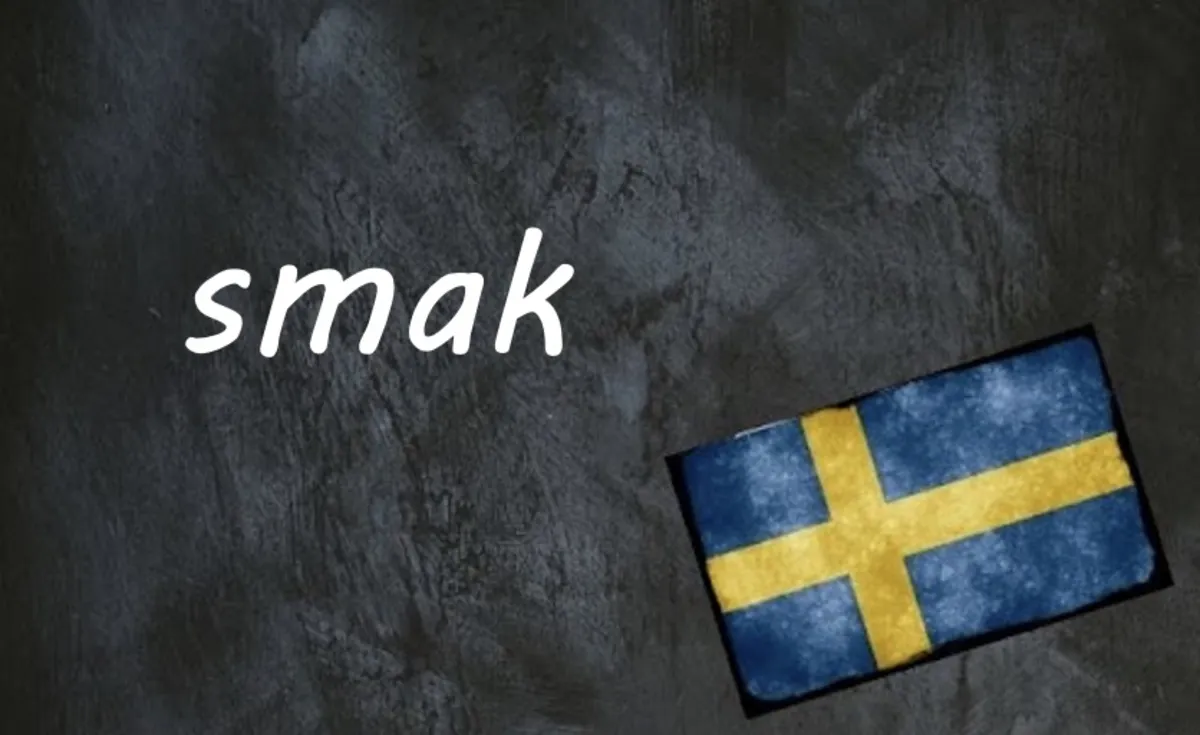
Smak means “taste” in Swedish, and the ‘a’ is pronounced ‘aww’ the way a North American would pronounce it, not like the ‘ahh’ in the English word ‘smack,’ but it can still be hard for English speakers not to read it that way.
There are a lot of chances to see smak in the Swedish wild, because it’s one of those words that show up all over food advertising and packaging – much in the same way "taste" does in English (e.g. "New Look, Same Great Taste!")
It also turns up in various forms: in addition to the noun (en smak, a taste) there's the verb att smaka, meaning "to taste". The (commonly used) present tense form of att smaka is smakar, not to be confused with the plural (indefinite) noun smaker ("tastes").
The noun smak is often used (particularly on food packaging) with the adjective god, a combination which can be particularly amusing to English speakers. God in Swedish means "good", not "God", and the vowel is, like with smak/smack, pronounced differently than in English, but god smak (literally "good taste", although in English we'd say "great taste!" in the same contexts) still can sound to an English speaker like a deity is whacking something.
- Don’t miss any of our Swedish words and expressions of the day by downloading our app (available on Apple and Android) and then selecting the Swedish Word of the Day in your Notification options via the User button
Tubes of toothpaste, for example, can describe their product as having god mintsmak, which always reads to me like a syntactically confused way of saying that the good lord is slapping around an herb.
Etymologically, smak, with the basic meaning of "taste" or "flavour", has cognates in most major Germanic languages, including English. Although the first meaning we tend to associate with "smack" in English these days is "to slap, hit", its older meaning of "taste" hasn’t fully disappeared.
The phrase “it has a smack of [X] to it", meaning "there’s a little taste of [X] in it" can still be legible to an English speaker, although it’s fairly rare. In this case, as in many others, English has replaced its native Germanic word (smæc) with a word taken from Old French: taster.
Example sentences:
Smakar det gott?
Does it taste good?
Klänningen var inte i hennes smak.
The dress wasn't to her taste (i.e. wasn't her style, she didn't like it)
Smaken är som baken – delad
The taste is like the butt – divided (to each their own)
Villa, Volvo, Vovve: The Local’s Word Guide to Swedish Life, written by The Local’s journalists, is available to order. Head to lysforlag.com/vvv to read more about it. It is also possible to buy your copy from Amazon US, Amazon UK, Bokus or Adlibris.