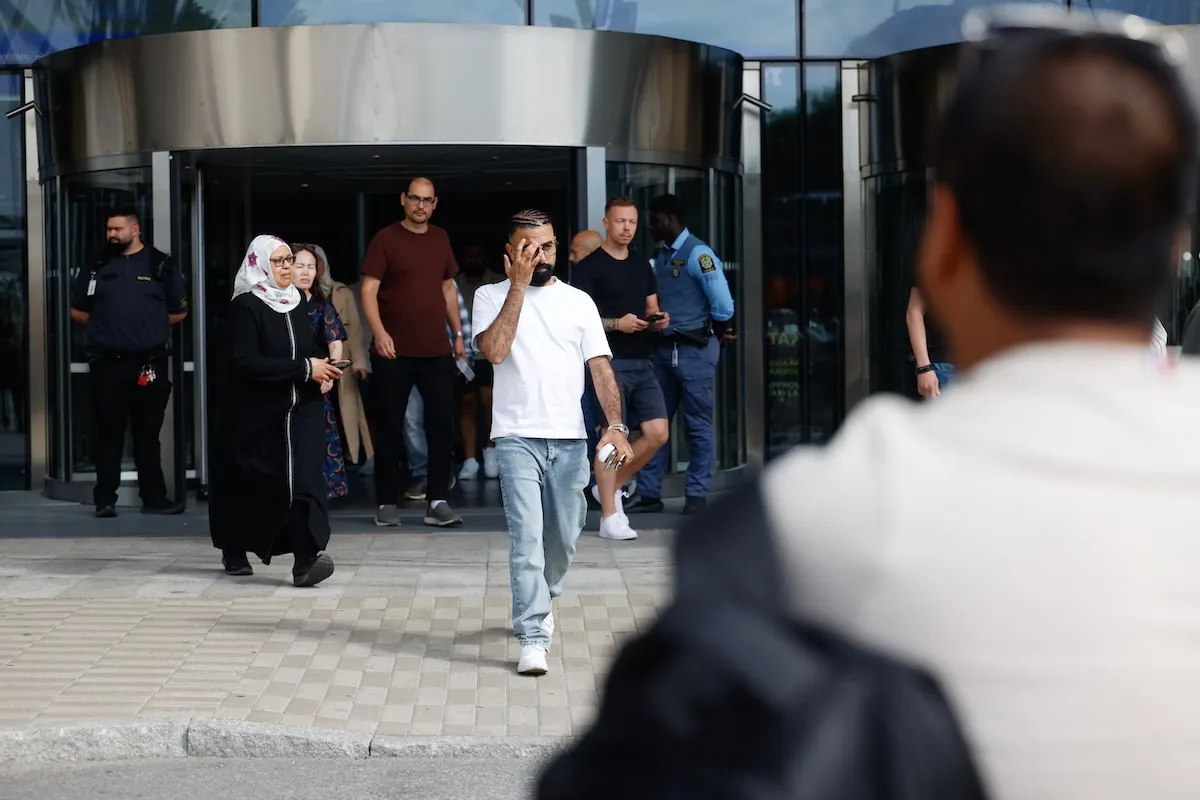
Sweden's first citizenship test on civic knowledge was held on August 15th, with about 1,000 people from across the country gathering at the Stockholmsmässan events and conference centre in Älvsjö, south of Stockholm, to sit the inaugural test.
Braam Collins, from South Africa, said that the test he took included at least three questions about the current government.
This means examinees were required to have current affairs knowledge that was not included in Sverige i Fokus, the booklet that the Swedish Council on Higher Education (UHR) had told applicants included all the information they would need to know.
"The questions were decent – some quite easy and some really hard to understand due to the level of language used," he told The Local. "They were all worded very strangely and nothing like I expected – nothing like the five example questions they gave."
"I felt it was a little bit difficult. I got confused with all the options," agreed Uma, from India, who claimed to have read Sverige i Fokus four times before the exam.
"We needed to have a bit of knowledge about politics: who is in government now and who was in government in the 1900s."
A woman from the Middle East, who worked in academia after receiving her PhD, said that she had also found the way the questions were set quite surprising.
"I know how one should make appropriate questions, but the test was not much like what it should be," she complained. "It seems like the test was made for a purpose of competition between people, or ranking the students, rather than evaluating their knowledge. That's my honest opinion, and I know this strategy because in the academic world we have learned how to create questions for tests."
She also argued that the test seemed to have a conservative bias. "There were NO questions about women's rights whatsoever! And not even LGBTQI," she said. "And the questions on children were very ambiguous! Not showing the importance of their rights, rather manoeuvring on the very non-important aspects! There were no questions on equality which is a very, very important characteristic of Sweden."
According to UHR, the language of the test was designed to match the lower intermediate level of Swedish required for Swedish citizenship.
But examinees complained that some of the words seemed harder, with for example the word nederbörd (precipitation) used in a question on the effects of global warming, while the booklet simply used the word regn (rain).
Despite their complaints, Collins and the Middle Eastern woman said they were quite confident that they had passed, estimating that they had got 80 percent or 90 percent of the questions correct.
The pass rate for the test has not yet been decided, with the council planning to decide on it based on the performance of the first cohort of examinees. For this reason, people who fails this round will be given a second chance.
"An analysis of the combined test results will need to take place," Dani Backteg, press officer at the Swedish Council for Higher Education, told the TT news agency.
The analysis will be carried out over the autumn, but according to Backteg, further information will be available "shortly".
UHR has told The Local that examinees will receive their results in October.