Quick facts
Party name in Swedish: Kristdemokraterna (literally "The Christ Democrats"). The full official name is Kristdemokratiska partiet (The Christian Democrat party).
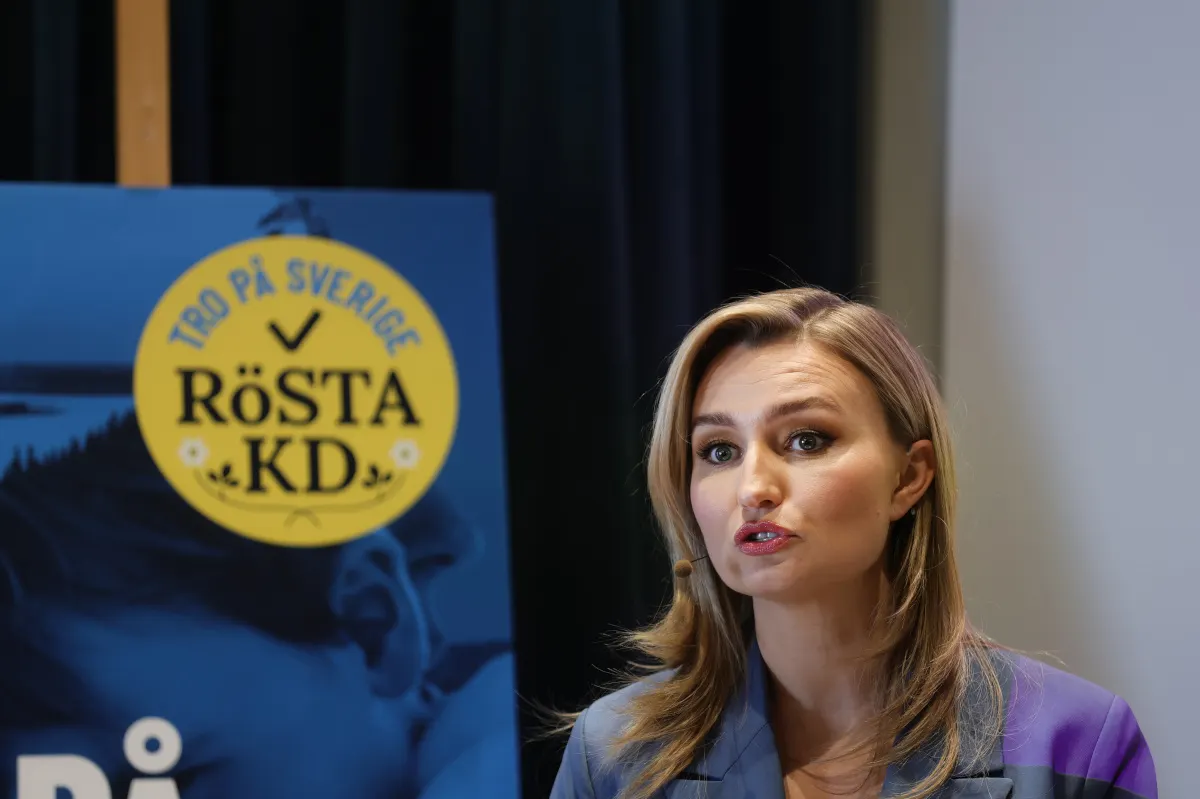
Leader: Ebba Busch.
Current number of seats in parliament: 19
Vote share in the last election (2022): 5.34 percent
Part of the current governing coalition?: Yes.
Current ministerial posts: Deputy Prime Minister (Ebba Busch), Minister for Business and Industry (Ebba Busch), Minister of Social Affairs, (Jakob Forssmed), Minister for Rural Affairs (Peter Kullgren), Minister for Infrastructure and Housing (Andreas Carlson), Minister of Health (Elisabet Lann), Minister for Public Administration (Erik Slottner).
2026 election slogan: Tro på Sverige (It has a double meaning: "Believe in Sweden", or "Faith for Sweden"), and Sverigedrömmen ("the Swedish dream").
Party background
The party was formed in 1963 on the back of a campaign against a decision to abolish religious education in schools which gathered a massive 2.1 million signatures. The party's founder, Lewi Pethrus, believed could be the foundation of a new party. While the party grew fast, it wasn't until 1985 that Alf Svensson became its first MP thanks to a cooperation deal with the Centre Party and not until 1991 that it had its real breakthrough in the Riksdag, when it won 7 percent of the vote.
The party has its roots in Sweden's evangelical or pentecostal "free churches" rather than the more staid Church of Sweden. During the long leadership of Alf Svensson, between 1973 and 2004, the combined conservative positions on the family, abortion and homosexuality with support for generous foreign aid, welfare and asylum.
Since its leader Göran Hägglund served as Sweden's Health and Social Affairs minister during the two Alliance governments from 2006 to 2014, the party has also claimed to be Sweden's healthcare party.
The party moved sharply to the right with the accession of Ebba Busch as leader in 2015, taking a tough line on law and order, largely abandoning its broad support for asylum (with the exception of family reunion), and accepting heavy cuts to the overseas aid budget.
Busch was the first party leader to open up to cooperation with the far-right Sweden Democrats, when she in 2019 met party leader Jimmie Åkesson for a discussion over meatballs. She also revived nuclear power as an issue during the 2018 election campaign, since when she has led the push to build a new nuclear power station in Sweden.
Key priorities in the 2026 election
Talking to journalists at the Almedalen political conference, Busch said her aim in the election campaign was to shift Sweden's right-wing bloc towards the political centre, particularly on tax and welfare, arguing this was the best way to close the gap on the opposition and achieve a "blue-and-yellow comeback".
She has argued that the next mandate period should be about making middle class life more affordable for ordinary Swedes rather than tax cuts for the richest, saying her party aims to bring the ideal of villa, Volvo vovve (detached house, Volvo, and dog), within reach of more families.
She has also been sending clear signals that she might be open to a cross-bloc cooperation with the centre-left Social Democrats after the election, although she has also stressed that she is campaigning in the election for a second term for Prime Minister Ulf Kristersson.
Family
The party is going into the election with a strong emphasis on "family politics".
The most eye-catching proposal Busch made in her speech at Almedalen was a pledge to almost double the monthly child benefit from 1,250 kronor to 2,000 kronor per child, something that would have been seen as bold even coming from the Left Party or Social Democrats.
As well as the child benefit hike, the party (along with the other right-wing parties) is also promising a new income tax rebate for families with children.
It aims to abolish Sweden's three months of use-it-or-lose-it parental leave (often called "daddy months", even though the mother could also use leave if they take fewer than three months), and to extend the time where parents are eligible for parental leave by six months.
The party also wants to make it mandatory for municipalities to offer places in familjedaghem, where childcare is offered in private homes, as well is in daycare centres.
Economy
The party has promised to cut taxes for low- and middle-income earners, arguing this will encourage people to move from welfare to work and will also have the greatest stimulus effect on the economy. It has pledged to raise the so-called brytpunkten, the income at which people start to pay state income tax, lowering the tax rate for many middle earners.
It is also calling for a doubling of the earned income tax rebate (jobbskatteavdrag) for over 55s, new immigrants and the long-term unemployed. At the same time Busch has stressed that the next government should not seek to cut tax for high earners.
Healthcare
As it did in the 2022 election, the party is calling for the state to take responsibility for delivering healthcare from regional governments. Although it failed to achieve this in the current government, it points out that a partial or total transfer of responsibility is under investigation by a parliamentary committee.
Giving the state control of healthcare perhaps has less emphasis than in 2022, however, with the party proposing a long list of other healthcare reforms.
It wants a "national healthcare exchange service" which will allow regional health authorities to easily identify and use free healthcare capacity in other regions to reduce waiting lists.
It wants to give all residents in Sweden the right to a permanent general practitioner or GP – a named doctor who is responsible for their care.
It wants to increase the number of hospital beds through bringing in a new government subsidy, performance-based compensation linked to overcrowding, and utlokaliseringar, or "relocalisation", which sees patients treated in a ward that is normally used for other medical conditions.
Finally, it wants to bring in a tougher "healthcare guarantee" for specialist care, requiring regional health authorities to treat patients faster than at present. The current government has already launched an inquiry to examine how to do this and the party hopes to receive recommendations and bring them in after the election.
Energy
The party is pledging to continue its efforts to build new nuclear power stations and to extend the lifetimes of existing nuclear plants.
Although it supports wind power and solar power in principle, it wants to keep the widely criticised municipal veto and ensure that any new projects "are developed with respect for local democracy".
Asylum and integration
In its Sverigedrömmen website, the party seeks to distinguish its approach to asylum from that of the far-right Sweden Democrats. The party calls for a migration policy that is "strict" but also "fair and reasonable", stressing that well-integrated former migrants should be welcomed as citizens and full members of society.
"Anyone who has come to our country, who has made Sweden their own, who shares our Swedish values, the Swedish language and has done everything they can to enter the Swedish labor market should also be able to fully participate in society and become a citizen of our country," it writes.
As part of this, it stresses that it wants to "protect the right to asylum" and highlights its role in pushing for a solution to the problem of so-called "teen deportations", which have seen 18, 19 and 20 year-olds deported without their parents to 'home countries' where they have often spent little time.
It also says it wants a shift to a system where asylum is primarily carried out through the UN quota system, which it argues would remove the incentive for asylum seekers to make dangerous voyages across the Mediterranean.
Education
The party wants schools to focus on providing an understanding of Swedish society, history, and cultural heritage, with a focus in particular on the "virtues and ethics that form part of the Christian and Western tradition".
The party has also called for a legally binding maximum of 12 children in preschool groups for children under three. It has called for smaller class sizes in general and for classes to be led by teachers rather than "screens".
While it supports Sweden's system of government-funded profit-making private schools, it wants the queuing system to he handled through a common municipal system to limit the ability of these so-called "free schools" to choose their own pupils.
It also wants tighter regulation of free schools so that "unprincipled operators can no longer cream off profits by cutting quality".
Religion
The party wants to extend the tax rebate for gifts to non-profit organisations it brought in under the current government so that gifts to cultural organisations can also be covered.
The party wants Sweden to recognise the genocide of Christian groups in the Middle East, such as Syriacs, Assyrians and Chaldeans, particularly in the period where the Islamic State terror group controlled large parts of Syria and Iraq.
The party wants to protect the right of religious organisations to run free schools.