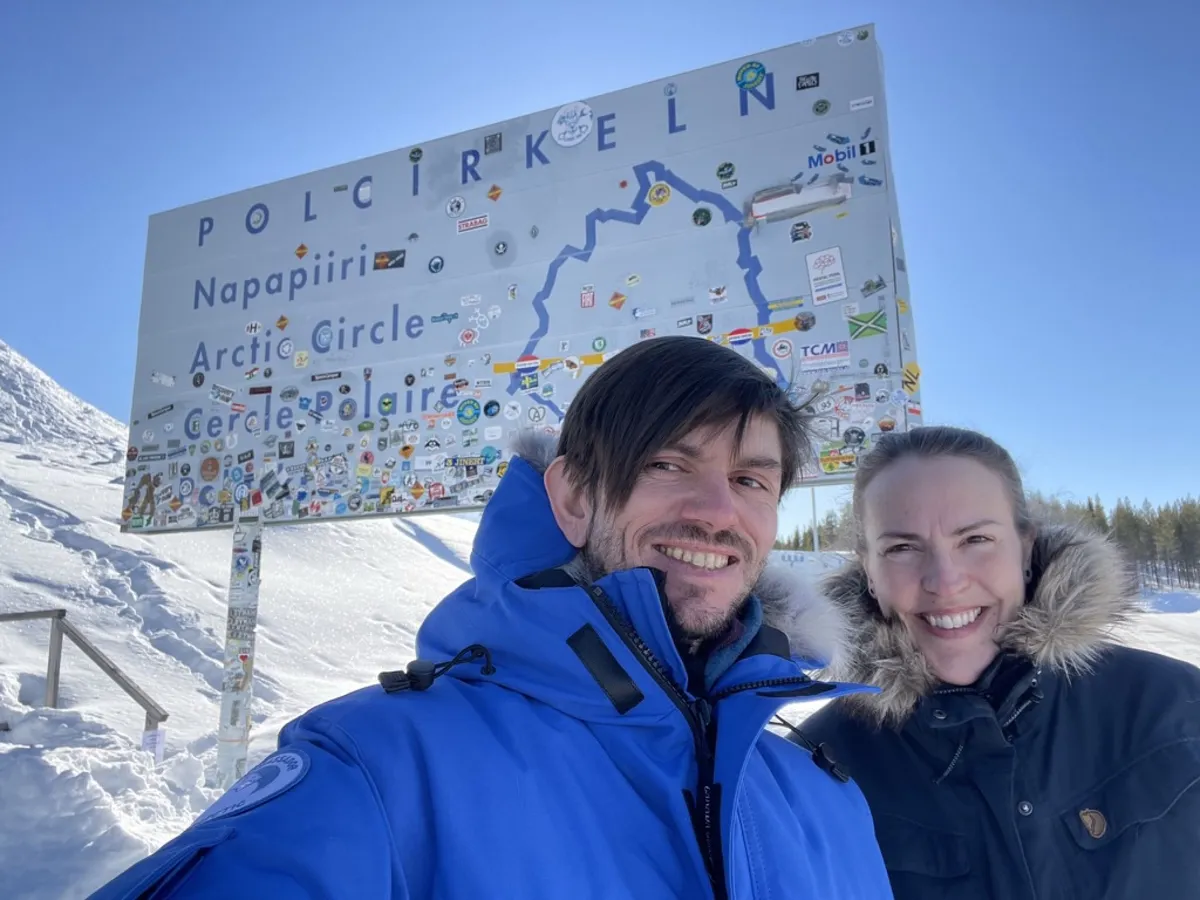
Chris Stamper, an American citizen and biosecurity researcher, had been living in Sweden with his wife and fellow scientist, Anna-Karin Palm, for nearly five years when he received a letter from the Swedish Migration Agency informing him he had seven days to leave the country or risk being barred from Sweden and put on a Schengen area blacklist.
His 'crime'? Applying for permission to stay in Sweden whilst waiting for a decision on his spousal residence permit application.
The default in Swedish immigration law is that the applicant must be outside of the country while waiting for a decision, even in cases where they are switching from one type of permit to another.
"If you read the actual law, it states that you may be exempt from this if you can prove that you have very strong connections to Sweden," Anna-Karin, a Swedish citizen, tells The Local.
"And if being married to a Swede, owning your own home here, having worked, being well integrated, speaking the language, if those are not strong connections, then what is a strong connection?"
Anna-Karin and Chris met a decade ago, when she moved to Chicago for a post-doctoral position in immunology and flu vaccine research. Chris, also a biologist, was finishing his immunology PhD at the same university. Three years later, Anna-Karin was moving back to Sweden for another work opportunity and the two, now a committed couple, made plans for Chris to follow as soon as possible.
Then the pandemic hit – but by the summer of 2021, Chris was on his way to Sweden, with a job offer from Karolinska in hand.
The two had decided that Chris should come to Sweden on the basis of the job he had secured, not their relationship, for a simple reason: the average processing wait times for a partner visa, which need to be applied for and approved while the 'partner' is not in Sweden, were so long and uncertain that they might have had to wait for years. A work permit application, however, went through in a few months.
'We know exactly why scientists are leaving Sweden'
In 2025, after four years in Sweden doing biological science research at Karolinska and buying an apartment with Anna-Karin, Chris was ready to change jobs: he now works with cutting-edge research into managing biological risks from AI systems. The couple decided it was time for Chris to switch to a residence permit in Sweden based not on his work, which is now international, but on his ties to Anna-Karin – his wife since 2022.
But to switch permit types in Sweden typically means having to leave the country for an undefined period of time. The couple met with an immigration lawyer who told them about a part of the law that allows for exceptions – if you have strong ties in Sweden, you can apply to be able to stay in the country while you wait on a permit application decision.
With a Swedish spouse that he'd been with for a nearly a decade, owning a home together in Sweden, speaking Swedish, and years of doing valuable work at one of Sweden's top research institutes, Chris and Anna-Karin figured he had a good case for exemption.
Yet his request was denied, and in January 2026 Chris received a letter from the Swedish Migration Agency telling him he had a week to leave the country. There was an option to appeal the denial, but the letter informed him that if the appeal was rejected, his pending application for residence in Sweden on the basis of ties to his wife would also be rejected.
"I had seven days to decide if I wanted to try to appeal and risk the entire application being rejected or leave Sweden for an undefined amount of time," Chris says.
The letter also informed him that if he did not comply with the order to leave the country within the specified timeframe, he risked being put on a blacklist for the entire Schengen zone.
"I'm not entirely sure why asking to just stay in Sweden while they decide on my other permit should [risk] having me blacklisted from the entirety of the European Union or the Schengen zone," he says.
"And it seems very strange to me that if you appeal their decision around the exemption and they disagree with that, it then becomes a rejection of the entire application, because with the cost-benefit of that, it functionally makes it that no one's going to appeal."
The two said they've seen Swedish newspaper articles wondering why scientists coming to Sweden for PhDs or postdocs often leave the country once their contract is up. To Chris, whose earlier work involved a patent for polypeptides that can detect and treat coronavirus infection, and Anna-Karin, who now works on vaccine development in the private sector in Sweden, it's no mystery.
"I saw this newspaper report....asking why are so many scientists leaving Sweden and 'How can we get people like you to stay?,' Chris says.
"And I'm like, well, don't kick them out in the first place, maybe."
'I felt betrayed by my country'
Chris flew to the US and worked remotely from his parents' home in Kentucky whilst he waited for a response from Swedish immigration authorities. Within a month, he had received a temporary residence permit and was able to return to his home in Sweden.
The cost of hotels and last-minute flights, including an emergency re-booked flight to the UK when Chris' flight to the US was cancelled due to snowstorms, as well as a trip for Anna-Karin to visit Chris "in exile," came to roughly ten thousand American dollars. But the couple say the emotional and psychological cost was higher.
"We were lucky in the sense that we can do this, we have the money to do it," Anna-Karin says.
"It's just the stress of not knowing. I think it's worse than anything. Because if you know that, okay, Chris is going to have to be outside of Sweden for six months, even a year, even longer, if you know that, you can plan for it. And....it's still not fun, but it's better than not knowing," she adds.
Chris says it was also the uncertainty that was hardest for him – as well as feeling like he was being treated like a criminal.
"I felt like I had done a lot of things right here and then to have a last-minute letter that's like, 'actually you need to leave our country because you don't meet the grounds for this exemption and if you don't leave we might just blacklist you from a bunch of other countries' – it felt a bit like a betrayal," he says.
It felt, he said, "like clearly they don't want me here. So do I want to live here long term or not?"
Anna-Karin, who was born and raised in Sweden and lived her whole life in the country, doesn't want to leave her home, but if her country continues to make life this hard for her and her husband, she says she will go elsewhere.
"I do want to stay in Sweden, but this whole experience...I felt like a rug was being pulled from under my feet and I felt betrayed by my country," she says.
"I lost faith in, like, every institution in the country. I feel like nothing works. I feel like one government agency doesn't know what the other one does and I can't trust anything. It felt like they clearly don't want my husband here, so if they don't want my husband here, I'm not going to want to be here either," she adds.
"I'm much less opposed to leaving now than I was before this," she continues. "So if Chris does get a job overseas, I will at some point move after him."
'Everybody is shocked'
Anna-Karin says that their experience with Swedish immigration authorities has changed her view of her country and its institutions.
"When Chris first moved here I kept defending things that didn't work," she says.
"I kept saying, this is not how it's supposed to be, or this is not how it used to be, or this is not what I knew it to be. But at some point during the four years before this whole thing happened, I kind of did that less and less. Now I've stopped defending things entirely. I can't defend things anymore."
Both she and Chris say that Swedish family and friends are shocked to learn that the strict immigration laws they hear about in the news affect them.
"Every time I talk to anybody about our situation, everybody, without exception, they're shocked," Anna-Karin says.
"They say, 'but that can't be right' or 'but surely they will do this' or 'but surely they don't mean that.' It's like, no – there's no, 'but surely', there's only these [laws], this framework, and that's where we have to fit into."
Chris has also encountered a widespread lack of awareness.
"People are just convinced [that] it will be super easy because I'm married to a Swedish citizen and speak Swedish and I'm a scientist," he says. "I've had people say to me, which I find somewhat distasteful, 'but you're the type of immigrant we want in Sweden, so of course these new policies, they're not for you. They don't mean you."
Anna-Karin says: "I think sometimes I think people don't even think about Chris as an immigrant."
"I think like family, friends, [they think] but he's married to me. That's their family. And they don't even consider the fact that there's immigration involved."
What Swedish voters should know
Chris thinks that some of the lack of awareness comes from the longstanding trust Swedes tend to have in their institutions – and a certain unwillingness to think that Sweden could be acting in an unreasonable way.
"There's a strong resistance to insult or criticise things that are Swedish or to believe that they could be improved or that maybe there is something that's wrong or worse than [how] other countries do it," he says.
"And so my advice [to voters] would be maybe to keep an open mind. Governments can make mistakes and Sweden's not exempt, no country is special in that regard. It's maybe not the worst thing in the world to sometimes be a little self critical on a national level and be like, 'Is this the right thing to do or is this the best for us?'"
Anna-Karin sees a worrying historical pattern at play in the anti-immigration rhetoric in Sweden.
"This is a scapegoat – people always want to scapegoat. And right now...I guess immigrants are a very easy target and it's not the first time in history," she says.
"And it's probably certainly not going to be the last time. But being extra hard on immigration is not going to fix all the problems that this country has currently."
"I think people need to stop and think and realise that it's not going to be a quick fix. There's a whole lot of issues that need fixing and being harsh on immigrants, making it impossible to live in this country unless you're white born-and-bred Swedish, whatever that means, is not going to solve things."