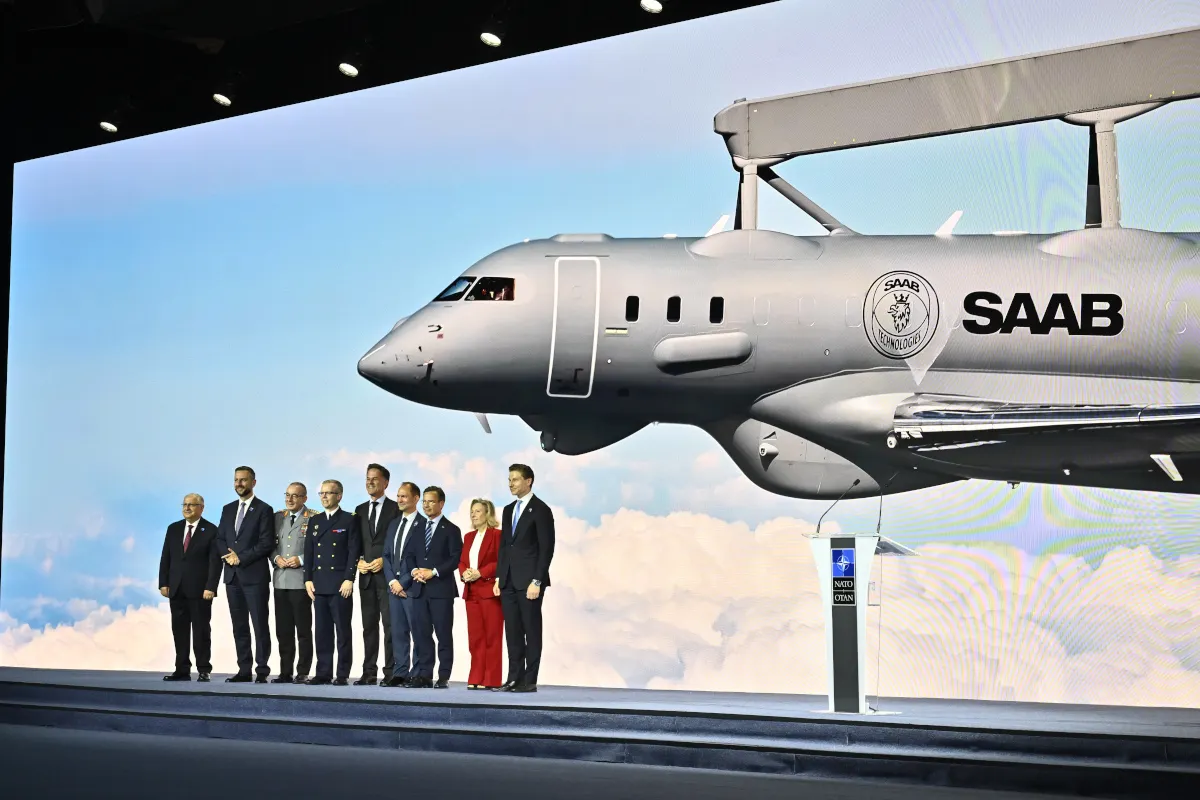
"This is a proud moment for Sweden," the TT newswire quoted Prime Minister Ulf Kristersson as saying.
It means that, for the first time, Nato will have an airborne surveillance capability that is not American.
The 14 Awacs aircraft that Nato currently relies on first entered service back in the 1980s and are beginning to reach the end of their lifespan, said Nato secretary general Mark Rutte.
The Globaleye aircraft are already in production and have been used for several years by the United Arab Emirates. According to Saab's CEO, they have performed exceptionally well during the Iran conflict.
Sweden is expected to receive its own deliveries of the aircraft in 2027.
"It is absolutely fantastic to have the opportunity to supply Nato with this capability," Saab CEO Micael Johansson told TT.
According to him, the Globaleye planes will be able to see deep into Russia, even while flying at a safe distance from potential attacks.
The fleet of up to ten Globaleye planes will be funded by 11 Nato allies, including Sweden, Germany and Norway. They will then be placed at Nato's disposal and will likely be based in Germany.
No contracts have been signed yet, and negotiations lie ahead. However, according to Johansson, the price for a single Globaleye aircraft is around 400 to 450 million dollars, equivalent to roughly 40 billion kronor for ten planes.
If the contracts are signed now, Saab could begin delivering four to six Globaleye platforms per year starting from 2030, Micael Johansson notes.
This will mean hundreds of new jobs in Linköping and Gothenburg. However, the aircraft themselves are manufactured by the Canadian company Bombardier, and key components will also be produced in France.
Kristersson attended the announcement of Nato's plans and described the day as a major milestone for Nato, Saab and Sweden.
"As prime minister, I am immensely proud of the Swedish defense industry and its engineering excellence," he said.