Germany has been battling an aggressive outbreak of OPMs this summer, as our sister site The Local Germany has reported, and they have again hit headlines in neighbouring Denmark.
"If the climate gets warmer and the caterpillar establishes itself in Denmark, it will very likely spread step-by-step to the Copenhagen area and subsequently appear in Sweden," Didrik Vanhoenacker, a biologist at the Swedish Museum of Natural History, told TT.
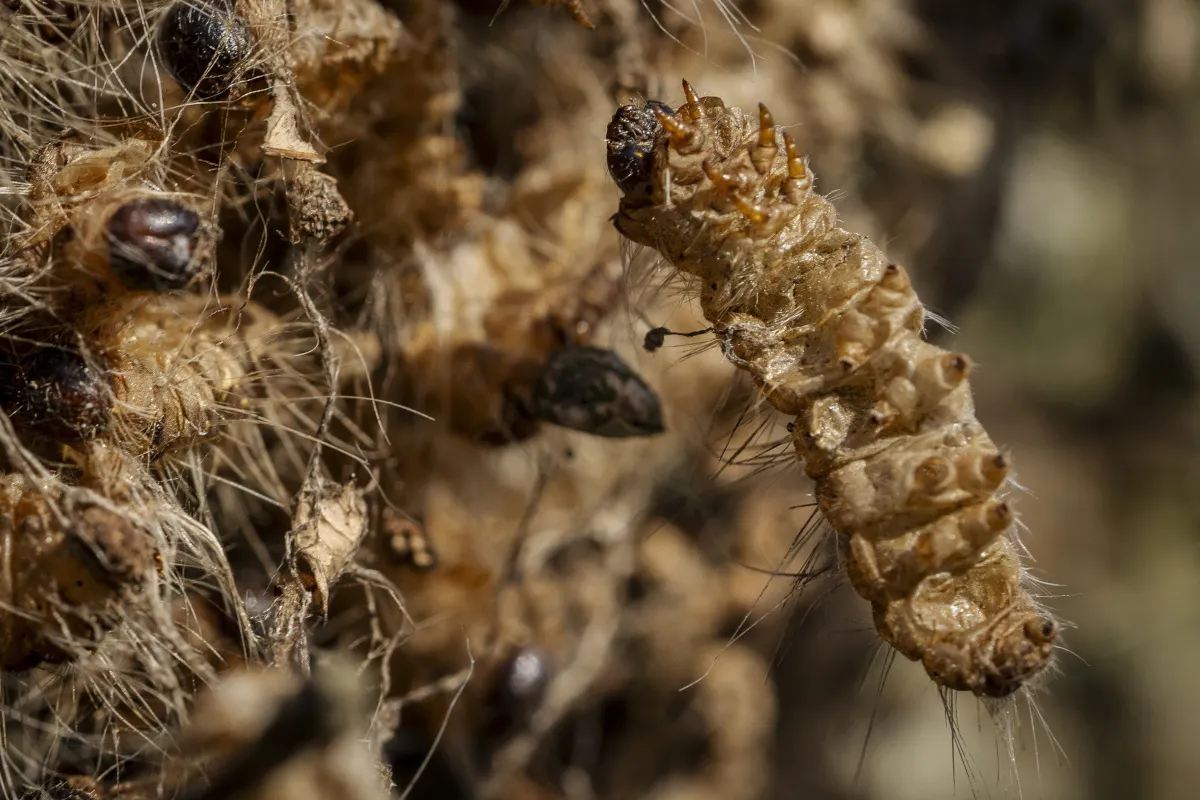
The OPM is a nocturnal insect which gets its name from the fact that it feeds on oak leaves, and the caterpillars move together in a procession-like line when searching for a new host tree. They build distinctive white-grey, web-like nests on tree trunks or branches, which can range in size from a tennis ball to a football.
The toxic substances found in the caterpillar's hairs can cause allergic reactions, severe itching and blistering.
"The oak processionary moth has been present in Central Europe for a long time, but it has now spread northwards across Europe. It can also be found further down towards the Mediterranean. It is a relative of the pine processionary moth, which eats pine needles and is already found in Sweden, primarily on southern Gotland," said Vanhoenacker.
The caterpillars build communal nests in the oak trees. Before pupating to become moths, they shed their skin several times. The shed skins, complete with the toxic hairs, remain in the nests, and the hairs can then be carried by the wind. People standing underneath a tree with a nest risk getting the caterpillar hairs on them.
Denmark's first live populations of the OPM caterpillar were discovered in Odense in 2024. Since then, the species has also been found in Nyborg on Funen and Horsens in Jutland, according to public radio broadcaster DR, which also reports that the Ørbækparken preschool in Odense was forced to close temporarily after several children suffered from itching and rashes caused by the caterpillar hairs.
It is possible that the OPM arrived in Denmark via oak trees imported from plant nurseries in Germany and the Netherlands, Vanhoenacker believes.
"Sweden also buys trees from other countries, and there is no way to know for sure if the OPM's eggs might be tagging along on the trees. The moth eggs are only a millimetres or so in size, so you have to look very closely to spot them. They are often found on trunks and thin twigs, and they prefer older oaks where they spend the winter," he said.
Odense residents are reportedly dissatisfied with how authorities have handled the caterpillar problem so far. A joint effort against the OPM is needed, according to Denmark's minister for environment and animal welfare, Christian Rabjerg Madsen, who has initiated a coordinated response with the relevant authorities and the country's municipalities, DR reports.