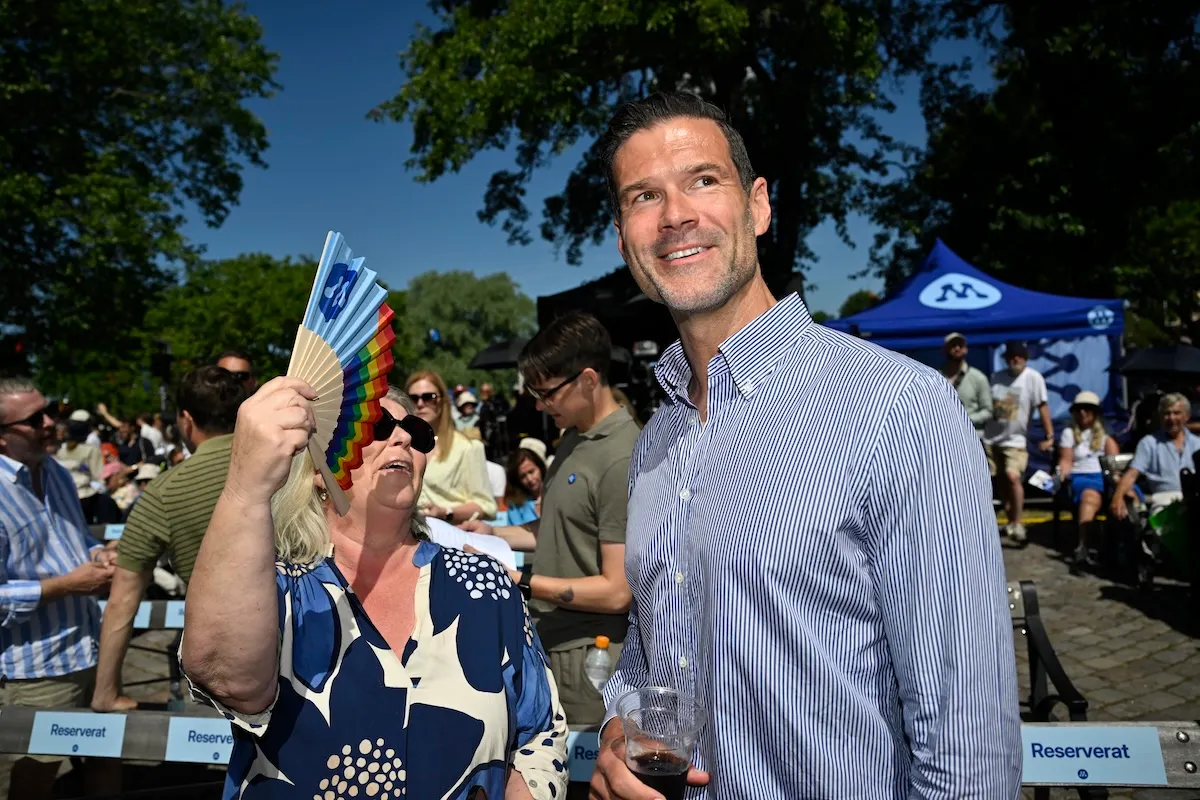
Whatever you think about the citizenship, asylum and work permit reforms driven through by Johan Forssell, you have to give him credit for being Sweden's hardest-working minister. When The Local meets Sweden's migration minister at the Almedalen political festival on Gotland, he's looking more relaxed than he has in recent months.
"This spring has been extremely intensive and still is intensive," he says over coffee and cinnamon rolls served in a ruined medieval building. "I think I've had 12 bills this spring, and on top of that we've had a breakdown in the parliamentary pairing system, so it hasn't exactly been easy. But we're pretty much there with most of it now."
He estimates that just two ministers – Justice Minister Gunnar Strömmer and himself – have been responsible for over 60 percent of the Tidö Agreement, the political programme the government agreed in October 2022 with the far-right Sweden Democrats. And because the government did everything by the book – with inquiries appointed and their conclusions sent out to consultation before bills are drafted – all the work hit his ministry at around the same time.
"There's been a high tempo. It's not like people should feel sorry for us, but the effort put in at the ministry has been immense because it's not just been delivering on the Tidö Agreement, which anyway involved historic changes, we have also had the issue of the deportation of certain young people which we have worked intensively to find a solution to."
The biggest problem faced by the Justice Ministry, which includes the Migration Ministry, has not, he adds, been dealing with the far-right Sweden Democrats, as many assume, but instead simply finding enough qualified judges and lawyers to hold inquiries and draw up all this new legislation.
On top of the workload, he's also had to deal with the personal attacks that come with the role of migration minister, something he did not experience in his previous roles as minister for trade and aid, or as chief of staff of Sweden's last Moderate Party prime minister, Fredrik Reinfeldt.
"I've worked on several different issues in my time as a politician, and this one is bloody well not easy, I have to say that," he continues. "You have to put up with so many things and so many abusive remarks: one day you're a Nazi, the next a left-wing activist. You get it from both sides."
When The Local asks how he has handled the pressure personally, he falls back on the words from the famous British Second World War motivational poster: "Keep calm and carry on!"
Forssell says he is proud of the laws that he has driven through, particularly on citizenship, even if a scandal over the parliamentary pairing system hogged the headlines.
"That shouldn't distract from the big picture, which is that we finally have a legal framework that is in line with what's in place in the rest of Europe: a language requirement, civics test, and a self-sufficiency requirement. These are all things Sweden has not had for 50 years."
READ ALSO: 'I feel scammed' – foreigners react to Sweden's controversial citizenship vote
The number of asylum seekers coming to Sweden is now at the lowest level since 1985, he continues, adding that he expects the Migration Agency's new forecast, published this month, to point to even lower figures to come.
The new law on deporting foreign citizens who commit crimes, will, he says, when it comes into force in September, make Swedish migration legislation in some ways tougher even than that in neighbouring Denmark.
"We've been going to Denmark for many years to be inspired by Danish policies, and when I met my new Danish colleague, he said that now Danish politicians are going to need to go to Sweden, because we are actually going to have the toughest rules."
The government's investigator, he says, has estimated that this will lead to a six-fold increase in the number of deportations.
In August, he says, the parliament will return to pass a bill that will partly make it harder for dependants to come to Sweden and partly solve the problem of teen deportations.
When I ask him what will happen to the proposal to revoke existing permanent residency permits for former asylum seekers (and some others), which was shelved earlier this year and sent to the Justice Ministry to be "improved" by an internal inquiry, it is clear that he would prefer it to stay shelved.
"This issue is being analysed and prepared extremely carefully and it has not moved forward that much," he says.
There is, he adds, no agreement between the government parties to enact it if they stay in power after September's election.
"The Sweden Democrats want to do it – that's no secret. But it's not government policy to do it."
He says that the cost is a major issue, and that the chair of the inquiry into the issue – who was a former Sweden Democrat official – had not fully investigated important issues over the pathway to citizenship for those stripped of permanent residency. But he downplays the chances of it being revived under a new government.
"This isn't the issue that has been the highest priority for the government."
Another possible future policy that he seems lukewarm about are overseas return hubs, which are now easier for EU countries to bring in after MEPs voted through a law giving EU migration authorities much broader detention powers and allowed for the creation of deportation centres outside the bloc.
When asked if Sweden would take advantage of this to set up return centres itself, he expresses scepticism.
"If you can find a country, please get in touch!" he jokes.
While the EU's law grants new possibilities, he points out, the idea has been around for at least a decade and no country has yet really made it work.
Sweden, he says, is working on return hubs with other Nordic countries, and would be willing in principle to use them to house rejected asylum seekers who refuse to provide identity documents or for some other reason cannot be returned to their home countries.
"I think this is important, but I don't think it's some kind of silver bullet for increasing returns, as there are a lot of other things we should be doing."
The example of the UK, he adds, whose plan to send rejected asylum seekers to Rwanda turned into a legal fiasco, is also, he says, a warning of the complexities.
"It can easily go wrong – take Great Britain as an example. I think there are probably more effective tools."
The question, he says, is whether a new Social Democrat-led government will reverse some or all of the migration reforms he has spent the last two years driving through.
"When it comes to the issues of deporting criminals, poor conduct, and even on citizenship, there is political conflict around this," he says. "They're all going to go through, but I naturally ask myself if they're going to survive if a new government comes in, because obviously any law that can be passed can also be reversed."
The Almedalen festival in some ways marks the official start of the campaign running up to next September's election (even if most politicians will now take two or three weeks off).
There were signs in the speeches of party leaders on the right of a softening stance on immigration, with Christian Democrat leader Ebba Busch in particular expressing her sadness that a young man of immigrant background had shouted at her "are you going to deport me?" But Forssell believes it's too early to conclude that immigration will not be an issue in the election.
"There's been this narrative that migration is no longer an issue, that now we should talk about other things," he says. "But I've said the whole time that I think this election is going to contain a large element of migration – just look at all the other elections out in Europe. It usually does."