Folk, it's a word you hear a lot in Swedish.
Every town has a Folkets hus, or a "house of the people", weak beer is "people's beer" or folköl. Adult education is carried out in "people's colleges" or Folkhögskolor, the Liberal Party was until recently Folkpartiet. There's everything from people's opera to people's dentistry, which begs the question for whom opera and dentistry would be otherwise.
Most significantly the Social Democrats' defining project of the twentieth century was to turn Sweden into a Folkhem, or a home for the people.
These institutions from the first half of the twentieth century, built on a longer tradition of national romanticism imported from Germany in the nineteenth century, are based on the idea of das Volk, a people with a common soul, a common language and common customs.
In 1930s Germany, these ideas were ethnicised and perverted by the Nazis. In Sweden, the interwar years in Sweden saw broad acceptance of the pseudo science of "racial biology", something that led to forced sterilisations, particularly among the Sami community, who were seen as racially inferior. To some degree these policies continued well into the post-war era.
This was a dark period, but today the idea of the folk is, for most people, a civic, democratic concept.
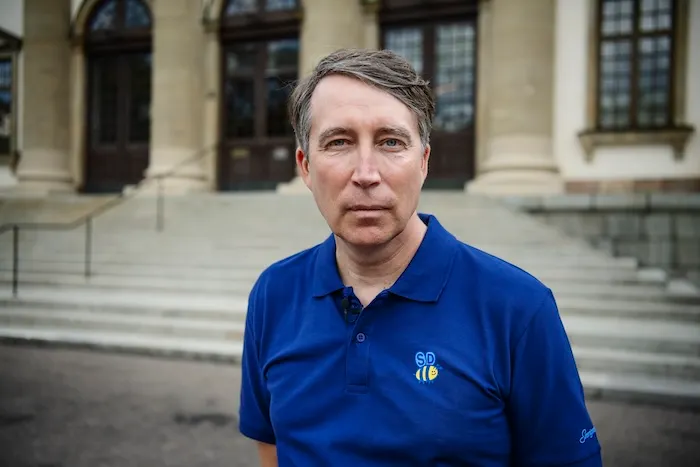
Yet among Sweden Democrats not everyone agrees. Richard Jomshof, a senior MP, has triggered a row after he tried to launch a blood and soil definition of Swedishness. In a post on X he asserted that there is "ett svenskt folk", a Swedish people.
The Swedish people, he said, "are the indigenous people of Sweden" ("Sveriges ursprungsbefolkning/urbefolkning"). For the avoidance of doubt, he attached a dictionary definition of those words, which stated that an indigenous people are "those ethnic groups that are descendants of the first human inhabitants of a particular geographical area".
Just think about that: the only really authentic Swedes are those whose ancestors have lived here since the dawn of time.
Jomshof conceded that this didn't mean that people who didn't fit his definition of Swedish had a lower worth (thanks).
Still, it's quite a bizarre (and unhistorical) claim: Sweden has seen waves of migration, from Germany, the British Isles, Finland and more recently from further afield. Stockholm's Old Town was largely built by Germans, the Swedish countryside is full of place names indicating that they were founded by Finns. The aristocracy is full of Scottish Hamiltons and Douglases. Sweden is not a migrant society like Canada or Australia, but it has long been a cultural and genetic mix.
This descent into ethno-nationalism couldn't come at a worse time for the Sweden Democrats.
Leader Jimmie Åkesson is acutely aware that his party was supplanted as Sweden's second largest by the Moderates in September's election; now some polls show Ulf Kristersson's party leading the Sweden Democrats by as much as ten points. With the centre-left seemingly bodging its chances of forming a government, there's maybe a 50/50 chance that Sweden will go to the polls again in a few months.
So it's easy to understand why Åkesson has now delivered a furious riposte in which he defended open Swedishness:
"People who believe that ethnicity defines Swedishness will get nowhere," he wrote in an article in Expressen. Without actually naming Jomshof, he declared that the people arguing for an ethnic definition of Swedishness were "egocentric, self-appointed ideological guardians".
"As a Sweden Democrat I don't hesitate to answer yes to the question of whether you can be Swedish even if you weren't born Swedish. To advocate for another position leads inevitably to bizarre conclusions that have no place in our party."
Åkesson is right (not a phrase you'll read too often on these pages): 35 percent of the Swedish population were born abroad or have at least one parent who was. 28 percent of those who live here were born abroad, or born in Sweden to two foreign-born parents. They are part of society and have the right to become Swedish; they include several party leaders and the entire royal family. They also, in fact, include Richard Jomshof, whose father was Finnish. Defining them as less Swedish than the others is absurd.
Many voters support strict migration policies, but ethno-nationalism has a tiny constituency, thank goodness. The Sweden Democrats can't afford to open the door to it.