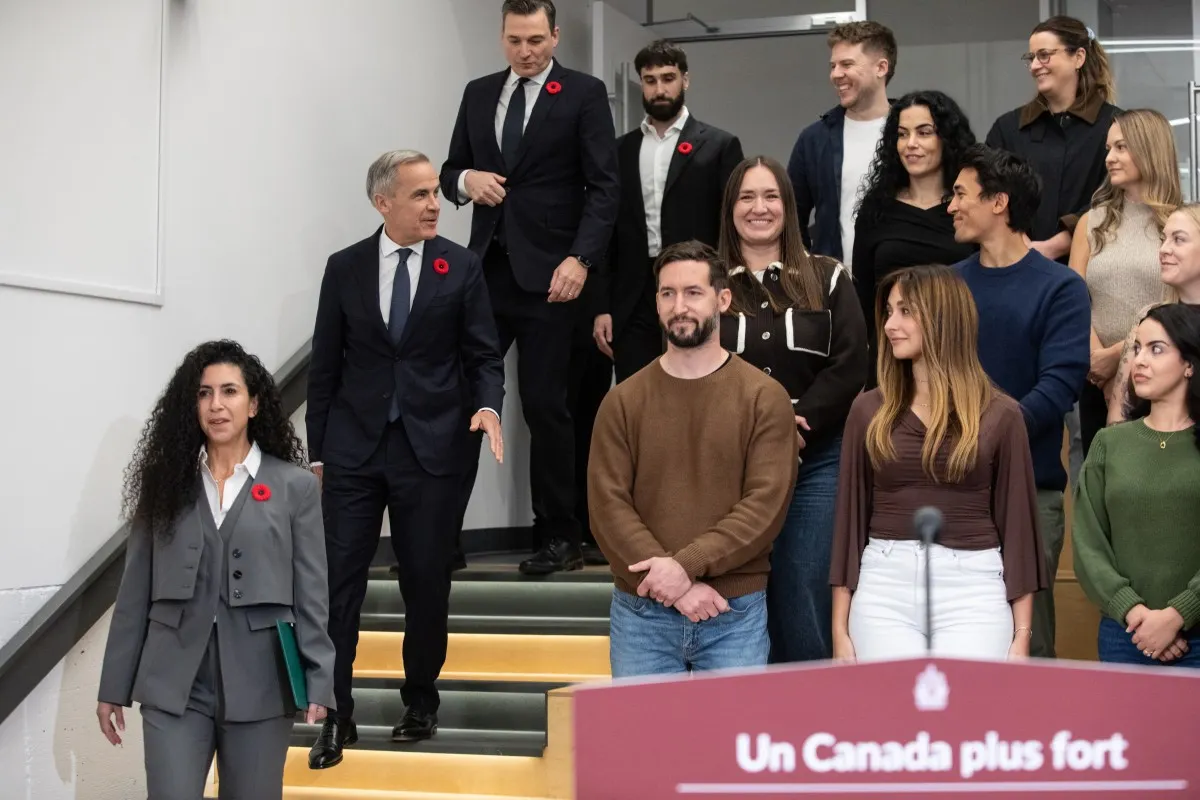
The two-day EU-Canada summit in Montreal, on October 29th and 30th, will address a wide range of issues with the perspective of launching the Canada-EU “Alliance for the Future” in order to “create a common prosperity and economic security space.”
The EU and Canada have both faced US tariffs under President Trump, who has also threatened of annexation Canada and Greenland (which is part of Denmark but not of the EU).
The draft joint statement set to be published after the summit and reported on by Politico says: “Closer engagement at the highest political levels will allow us to exchange views, identify shared priorities and coordinate our responses to common challenges.”
'Enhancing labour and researcher mobility'
The draft statement also says that “Canada and the EU will expand opportunities for Canadians and Europeans to study, work, conduct research and build lasting connections and cultural exchanges across the Atlantic.”
“Canada and the EU will launch negotiations toward deeper participation in Erasmus+”, the EU flagship programme for education, training, youth and sport, the draft continues.
Discussions should also be launched on “cooperating on skills development and enhancing labour and researcher mobility, and talent attraction, with a focus on reducing barriers for young people and facilitating mobility for highly skilled workers and researchers and promoting greater recognition of professional qualifications”.
In this regard, Canada and the EU will explore a “next-generation Youth Mobility Partnership that will further enable young Canadians and Europeans to access opportunities across the Atlantic through a more integrated mobility framework,” the statement is expected to say.
A joint press conference is planned at the end of the summit, on Friday evening, with European Commission President Ursula von der Leyen, EU Council President António Costa and Canada Prime Minister Mark Carney.
The new partnership builds on the EU-Canada Comprehensive Economic and Trade Agreement (CETA), a free-trade pact signed in 2016 which is not fully implemented yet. Canadian officials have said businesses are pursuing new opportunities in Europe to offset US tariff-related losses, AFP reported.
Talks will also aim to align policies on climate, energy, artificial intelligence, critical minerals and infrastructure investment.
Bringing the relationship to the 'highest level possible'
In September, President Ursula von der Leyen offered Canada to become the first EU associate member.
At an event on the sidelines of the summit, on Thursday, von der Leyen said: “It has become clear that there is more that we can do together bilaterally, Canada and the European Union. Canada cannot become a full-fledged member of the EU because of geography, but we both want to bring our relationship to the highest level possible. This is why we are discussing the idea of Canada becoming the first associate member of the European Union.”
Several EU countries, including Germany, France and Italy, however, have objected to the words “associate EU membership” in the final declaration because EU treaties do not include any provisions on such status.