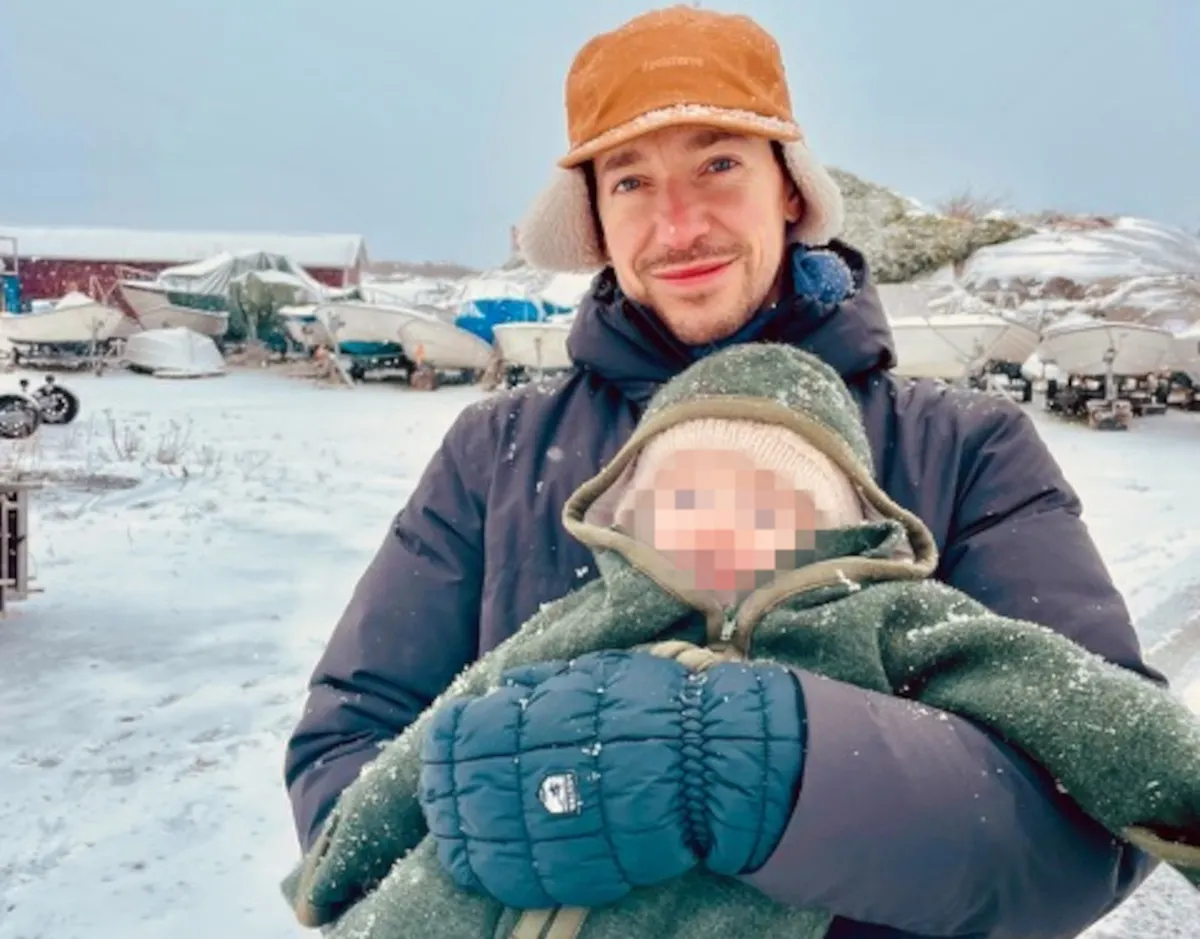
Simon Montgomery describes his son, River, with the enraptured adoration any new parent will recognise.
Although the child, the result of a whirlwind romance that's now ended, wasn't planned, Simon is determined that he will grow up with a loving, present father – so determined that he packed up his UK life to move to Sweden, where the child's mother lives, to be there for the birth and the key early bonding moments.
But his warm parental smile falters when he begins talking about how, from the time his son was six months old, he has been in a protracted fight with the Swedish state to be able to continue being a core presence in his son's life.
"We have a joint parenting agreement, shared custody," Simon tells The Local of his co-parenting arrangement with River's mother, after The Guardian first covered his story. "I pick him up from schools on Thursdays and we have a great time. I'm with him all day Saturday and all day Mondays. And the Swedish Migration Court said that if I was to leave, it won't interrupt my ability of being a parent to him because I can come visa-free to Sweden."
"Sometimes you're speechless through what has been said to you, or what has been implicated."
What is the child's best interest?
River's mother is a German citizen, not Swedish, so River, too, is in Sweden as citizen of the EU, not Sweden. The mother, however, has been building a life in Sweden and wants to stay – a right that Simon respects, even though they're no longer a couple.
What he has a harder time understanding, he says, is how Sweden – a country known for being a world-leader in children's rights and ensuring fathers are intimately involved in childcare – can in all seriousness be claiming that deporting the father of a 17-month-old, a father who has been joint caregiver since the baby's birth, won't have a very big effect on the child.
"I think that's the hardest thing to understand here," he says. "Everything in Swedish law, from what I understand, is about the child's best interest – barnets bästa, they call it. And what is the child's best interest? Having both parents around, you'd think. Unfortunately, whatever migration policies have trumped that, have been more important than the child's best interest."
Simon, who has a successful professional photography career, says that while he does love many things about life in Sweden, the only reason he wants to stay in the country is because he is certain it's in the best interests of his son.
"He's the reason I'm here. It's a beautiful place, I feel like the seasons are more powerful here and you can find a lot of comfort in nature, but it's hard not to get angry with the system. It's hard not to get annoyed with them taking away my ability to show up the best I can for my son."
"There are so many changes that happen when you become a father and when you become a parent. I feel an overwhelming responsibility to be here for my son. And the first three years are by far the most critical three years."
'Where is the humanity?'
Simon's first rejection decision from the Swedish Migration Agency came in December 2025. Recently separated from River's mother and dealing, he says, with "heartbreak", he had tickets to go back to the UK for a short time to be with family over Christmas.
But the Migration Agency's refusal of his case right before the holidays meant he had a very difficult decision to make.
"When I had my initial refusal, there was a removal order, meaning you're not allowed to travel. So this meant at the airport when I went to fly home last Christmas after what was a very challenging year for me, probably the most challenging of my life, to see my friends and to see my family and spend Christmas, I was told if I was to leave, the chances were very slim that I would be allowed back in the country until after the [court appeal] decision."
"So I had to make a decision to be here for my son and continue my parenting responsibilities and to build that bond. So I spent Christmas alone. And I still haven't had a chance to go home yet. It's been over a year since I've been home. My grandmother is 98, and she's not doing so well. I (...) would like very much to be able to see her, to bring River to see her."
His appeal was heard by the Swedish Migration Court in September 2026. It was a closed hearing, Simon tells the Local, "just the judge and the immigration lawyer, and then your statement".
"They don't take statements from any of the family services, any of the people from his preschool, any of our relationship counsellors, even like our church pastors or people who know us in the area. I requested an oral hearing, and it wasn't even acknowledged. So I wasn't there to defend myself or to show any kind of humanity, to show that this is a child being separated from his father, who is one of his main caregivers here."
His appeal was denied. He could, the court ruled, maintain his "family life" by visiting Sweden from the UK "visa-free".
The court also reasoned that because his baby son, who is still breastfeeding at nights, does not regularly sleep over at his father's home, Simon must not have a sufficiently strong caregiving role to warrant staying in the country – at least, not when "weighed against the state's interest in controlled immigration, in a proportionality assessment".
'A year of endurance'
It was after the court ruling that Simon decided to take his story public. He describes getting through the past year of living with the daily fear of being separated from his son as being a question of "endurance".
"It's been a lot to carry and it's been a year of endurance. You're unable to plan anything long-term. You try to be positive and try to, you know, enjoy the beautiful nature here and the nice things there are to do. But it's almost like hiking through a forest with a pair of boots four sizes too small for you. It's just too painful at times."
"Every time you have your child (...) you want to be as present as possible, to learn about him and have him to learn about you. But it almost feels like you're going to war – like you're going to have to leave and you don't know when you're going to see him again."
There has been a large financial impact as well. Simon's work is international, and without being able to travel for photography jobs, he has, he says, "lost tens of thousands of euros in earnings".
"I didn't want to use my savings for this, I wanted it for a house and family holidays and trips to see relatives and to raise my son. And instead I've had to use it for legal expenses, supporting myself. But then I also weirdly think I'm the lucky one here. I am one of the lucky ones because I can afford to do this. But it's painful."
Simon emphasises, though, that he doesn't see this case as about him – or about Brexit, which happened long before he came to Sweden for the birth of his son in 2025.
"It's interesting sharing my story," he says, "because people say it's about Brexit and about me, where it's not about me whatsoever. Obviously that's part of my story, but this is my son, who is an EU citizen who falls under EU laws, and all I'm asking is for the law to have his best interests at the heart of all decisions."
A puzzling contrast
What Simon finds perhaps hardest to understand is the contrast he experiences between the kindness, compassion, and understanding of Swedes in his everyday life and the harsh immigration rulings of Swedish institutions, which, he says, seem to exclude anything human from the picture and, instead, "find the weakest part of your argument and attack it".
"It's beyond a contrast. It's so polar opposite – the kindness and the generosity that I get from Swedish people is not portrayed by the court and the government. It's been a strange parallel to live through," he tells The Local.
"I feel like it's a beautiful country with kind people who generally go out their way to try to help you. Like, when I wasn't allowed to go home last Christmas, my landlords downstairs invited me around for Christmas fika, their son was back from where he lives in Berlin and brought some fantastic wine – and it was just so heartwarming."
Echoing what other interviewees facing family separation in Sweden have said, he describes Swedes being stunned when they hear what is happening to his family.
"Most of the people who I speak to are generally incredibly shocked when they hear what's happening, to such an extent that they look confused. Even people in other government organisations, and family services. When I told one family service worker [what's been happening with the immigration authorities], he actually said to me 'this is the most heartbreaking story I've ever heard in my career'. He was crying. And he said he's been here for 25 years. And my British sense of humour immediately went – that's good. Great. I've got number one. I've always wanted to be best at something."
'People do not understand what goes on
When asked what he makes of the discrepancy between the Swedes he meets in his daily life and the actions of the immigration system, Simon puts much of it down to a genuine lack of awareness – a main reason why he decided to go public with his story.
"I feel like lots of people do not understand what goes on. There's maybe not transparency because the more transparency there would be, the more accountability there would be. And the more things would change or people would stand up against certain things."
In close parallel with other people in comparable situations that The Local has profiled, Simon describes Swedes in his close circle finding the actions of Swedish immigration authorities outrageous enough that they initially assume he has made some kind of mistake, or done something wrong.
His Swedish friends, he said, "feel really quite shocked when I tell them. I've had to even email some court papers because they thought I must be making a mistake, there must have been something wrong ticked somewhere, or I applied for the wrong thing, or I must be translating it wrong. And then they realise I haven't. I've done everything by the books and everything correctly."
But despite everything, Simon is determined to stay in Sweden as long as his son remains here. He himself grew up with a father far away in another country, and does not want the same thing for his child.
"Most people will know that the stats about especially boys growing up in fatherless homes," he says. "We all know about the mental health problems of our children nowadays and here in Sweden, with especially young men, you hear tragic stories, and it's like – I need to be here, he needs to know I'm here for him, he needs to know he can rely on me."
Ultimately, this conviction makes it worth it for him, he says.
"I feel like if I could put my feet on solid ground and stand here, I could face anything else because of the love I have for him."