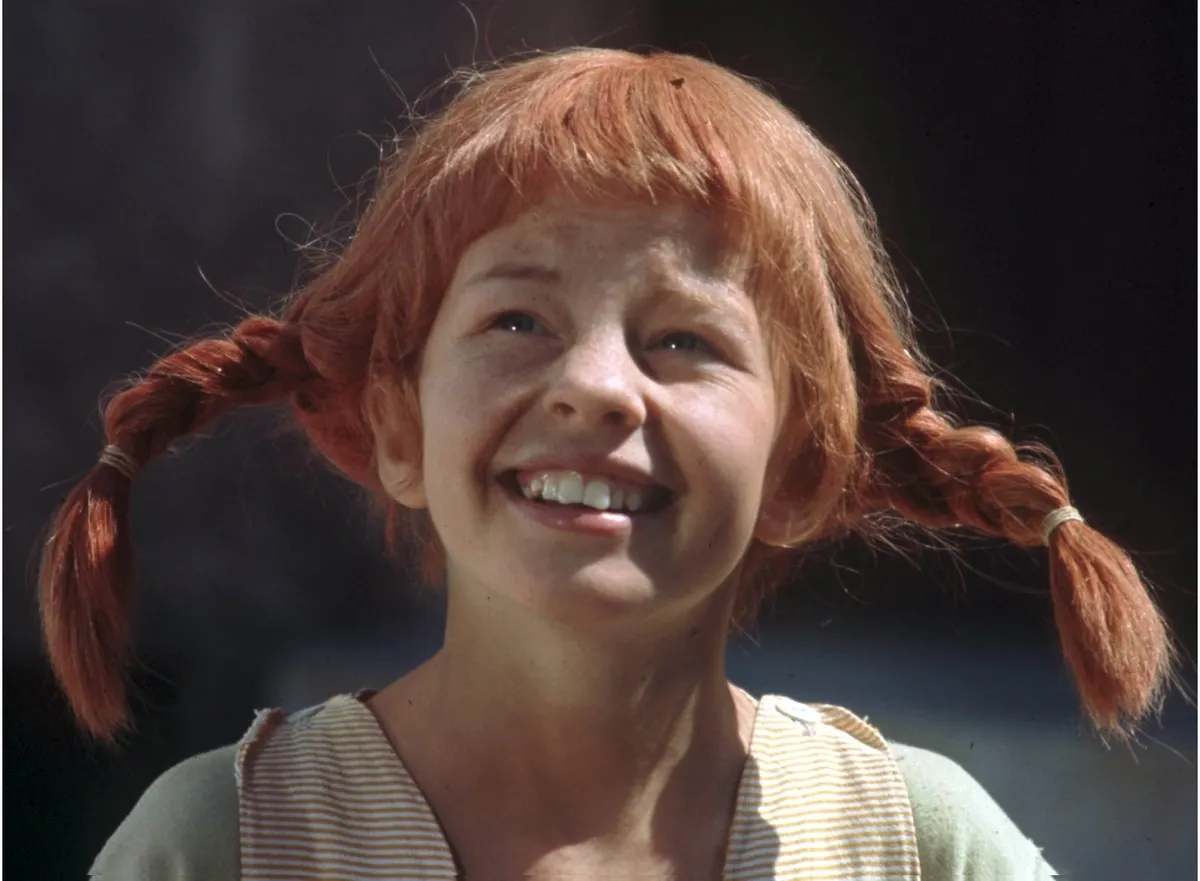
When I was about seven years old, I scrounged up every hair elastic I could find and used them to corral my pigtails into sticking straight out from the sides of my head. It only sort of worked, but that was good enough for me – as long as I could go to school looking as much like Pippi Longstocking as possible.
I'd read Astrid Lindgren's Pippi books (in English translation, naturally) and also seen some episodes of what I now know to be Swedish public broadcaster SVT's classic 70s television rendition; my mother borrowed the VHS tapes from the Toronto Public Library.
Those VHS tapes of the Pippi SVT show were probably the only thing I watched in a language dub as a child. Not that I knew that at the time: I just remember thinking that the mouths on that show moved a bit strangely; I think I put it down to it being "old".
I had no idea Pippi was Swedish – I doubt, as a younger child anyway, that I'd even heard of "Sweden" – and I'm not sure I really knew until I started dating a Swedish guy, in my 30s.
What I knew as a child was that I loved Pippi Longstocking. I loved how strong she was (literally strong: if you're not yet familiar, this is one of Pippi's core features – being able to easily lift, among other things, her pet horse), how independent, how absolutely wild and yet somehow always perfectly in control of any situation.
As an adult, I've returned to Pippi – as a post-secondary children's literature instructor, as a parent, and as a lifelong lover of kids' books – and, some old-fashioned, ignorant portrayals of south-sea islanders aside, I've found it even better than I remembered. Astrid Lindgren is a master word stylist, storyteller, and creator of characters; her people jump to life with a few pen strokes and pull you rapidly along for a ride you never want to get off.
And in the way of all excellent children's literature, the Pippi stories are adored by children and yet also have elements which can only be appreciated by adults. As someone who has seen a lot more of the world than seven-year-old me, the classic "coffee party" story, for example, in which Pippi busts up a genteel gathering by being, well, Pippi, has a whole other layer of delight.
This story was one of my favourites as a kid: in it, Pippi's foils – her well-behaved friends and next-door-neighbours, Tommy and Annika – invite her over to their house for a fika their mother is hosting for some of her polite, middle-class, lady-friends. The children have their own little table in a corner and are expected to sit there enjoying their sweet treats and minding their own business.
Pippi enters the scene with red crayon smeared on and around her lips in a mad attempt at makeup, barking orders at herself like a general on how to enter the sitting room. From there it only gets more chaotic: the ladies, in true polite Swedish fashion, attempt to simply ignore her, but after she knocks the sugar bowl all over the floor, pushes everybody else aside to pile her plate full of all the best goodies, sticks her face in a pie so as to get the most out of it, and constantly interrupts the adult conversation with outlandish tales, the hostess finally loses it on her.
Children love this story for obvious reasons. As an adult, I love it for its wicked and witty mockery of middle-class norms: the "polite conversation" Pippi continually interrupts are the middle-class women complaining about their servants.
"I don't wish to complain about my Birgit," one genteel lady says, "but she does drop the china." Pippi then interjects with a long, rambling, exquisitely entertaining story about her grandmother's servant named Malin. Malin, you see, always broke the china, but one day she was sick and couldn't do it, and grandmother was oh so upset because she had to break the china herself! Poor grandmother simply wasn't as good at it as Malin, Malin had so much more practice.
A complete Swedish silence greets Pippi after her first "Malin" story, and the ladies continue on as if she hasn't said anything. But Pippi is nothing if not irrepressible, and her interjections – all with "Malin" stories, each more madcap than the last – continue, until, at long last, Tommy and Annika's mother overcomes her fear of making a scene and kicks her out.
Pippi is briefly downcast, but recovers her spirits quickly, chasing the departing ladies down the road after they leave to deliver a final bit of Malin lore: "and she never cleaned under the beds!"
It's only now that I'm making my home in Sweden that I understand just how Swedish some aspects of Pippi are: a story of a fika gathering centred around conflict-avoidant social norms, a yellow ramshackle villa at the edge of a quiet town, and nine-year-olds drinking coffee on the porch.
Also quite Swedish, it seems to me, is a certain respectful attitude towards childhood and children. Pippi is in some ways the deity, or patron-saint version of a certain Swedish approach to childhood – one where children are neither coddled nor whipped, where they are treated with a certain affectionate, amused detachment, as independent little spirits in their own right.
For that alone – that it is the home of Astrid Lindgren's singular creation – living in Sweden will always have a certain magic for me.
What's your favourite Swedish children's book? As Sweden's annual "reading break" for schoolchildren gets under way, we want to know what Swedish children's books have had a real impact on you or your children. Fill out The Local's survey, or post your top recommendations in the comments.