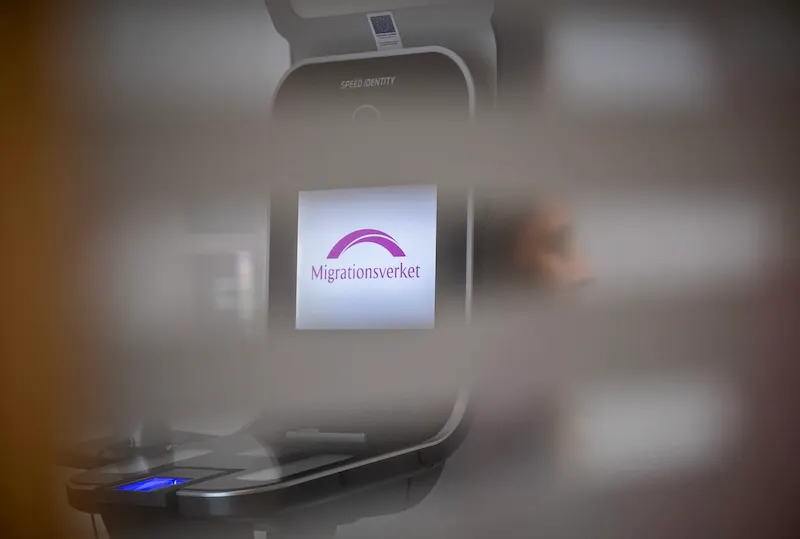
Sweden has deported more British people than any other EU country.
These were people who had moved to Sweden under EU freedom of movement, who had made their lives here, who were often extremely well-integrated and had half-forgotten that they weren’t technically Swedish. People whom the EU and Britain had promised could stay, and who were nonetheless kicked out.
In her interview with Richard Orange, Migration Agency legal chief Susanne Fonsell comes across at times as evasive.
At one point she tries to deflect Richard’s questioning by claiming, hilariously, that she’s “not a specialist” on applying the Brexit migration rules. But if the head of legal at an EU country’s immigration authority is not a specialist on applying EU immigration law, who on earth is?
But the interview was also revealing of the agency’s culture: it sees its job is to be a control agency, not a service agency.
Brits who lived in Sweden prior to Brexit kept rights that were already theirs.
That contrasts with asylum and family reunification, the cases the Migration Agency is used to dealing with, which work the other way round. There, the state grants permission — and in the past decade the state has been turning the screws to make this harder.
It’s clear from her interview that this culture has pervaded all aspects of the agency’s work.
Fonsell also demonstrates a peculiar understanding of proportionality. Under EU rules, her agency was not permitted to deny Brits residency permits if to do so would have been disproportionate. But in response to our question about proportionality she protests that “the legal system must be based on rules and not emotion”.
And so, she seems to effectively dismiss the whole legal concept of proportionality as being a matter of emotions.
If the failures at the Migration Agency were limited to Brexit it would be a short-term problem: incredibly, cases are still emerging, but in a year or two they will stop as Britain’s exit from the EU recedes into the rear-view mirror.
But the incompetence over Brexit is only a symptom of a wider malaise.
For years, The Local has been highlighting the Migration Agency's failures: its staff regularly give incorrect advice to work permit and citizenship applicants, it issues deportation orders over minor admin errors, even when those concerned are willing to correct them.
It repeatedly denies people the right to stay, or even citizenship, for being in Sweden illegally — even when the only reason their permit has expired is that the agency has let their case sit in a pile for too long.
Most Swedish parties want Sweden to limit the numbers of refugees and discourage low-skilled migration. At the same time they actively want high-skilled immigrants. They also have a duty to apply EU law correctly and to give Swedes who fall in love abroad the chance to bring their partners home.
It is clear that the current system is not set up to do all of this at once. The Migration Agency gives shoddy advice, lets cases pile up and then issues rejections on technicalities, even when those rejections are clearly disproportionate. The Migration Courts act as industrial-scale rubber-stampers of agency decisions.
Here, Brexit is an excellent illustrative example: the courts haven’t referred a single Brexit case to the European Court of Justice, despite the fact that important points of EU law are at stake.
Absurdly, the Migration Court of Appeal will only take up cases if they set a precedent, a rule it interprets so narrowly that we are not aware of a single Brexit case that has been heard there.
The agency would presumably point to the fact that it is underfunded. It would also say that it is only applying the law. But how agencies apply the law, how they treat the people that interact with them, is also a matter of culture.
And the culture of the Migration Agency is one of control, when many of its tasks demand a culture of service. The current system is no longer fit for purpose.
The solution is clear: The Migration Agency needs to be scrapped in its current form. It needs to be shrunk back to deal only with asylum cases, the only cases that it is institutionally capable of handling.
Sweden should then set up a service-minded agency to deal with work permits, along the lines of Denmark’s Agency for International Recruitment and Integration.
It would make sense for that agency to deal with citizenship too — the overwhelming majority of citizenship applicants have been Swedish taxpayers for years, and should be treated as such.
That would leave the rump Migration Agency to deal with asylum cases, a task that deserves its full attention. The current bureaucratic farce cannot be allowed to go on.