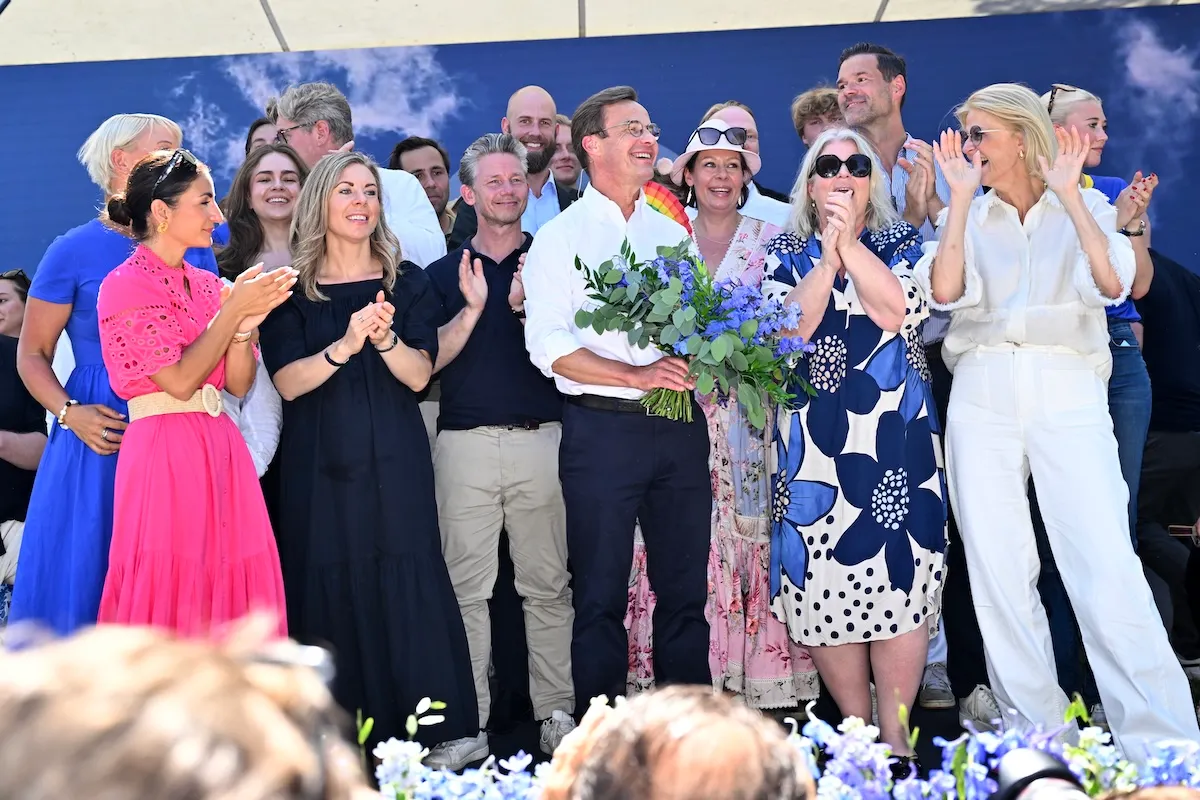
As soon as Ulf Kristersson stops speaking, Moderate party ministers climb on stage to join him, clapping, swaying and dancing to their party's peppy election song. It's clearly intended to give the sense of an optimistic party celebrating the end of one mandate period and looking forward to the next.
But like the cheers from the young activists handed yellow and blue Moderate football shirts that morning and sent to applaud wherever Kristersson speaks, it doesn't quite come off. Instead, as Migration Minister Johan Forssell bobs from side to side grimacing, a head taller than his prime minister, it feels like the awkward dancing at an office leaving do, a farewell from a party on the way out.
The Local can only find one Moderate who will say that on the record, though. Roger Wärn, a councillor for the party here on Gotland, the island where Kristersson is speaking at the Almedalen political festival, says that in his opinion, the right-wing bloc's chances of victory in September’s election are "doubtful".
The tax cuts and subsidies the government has showered on voters over the past few months will not be enough, he believes. “It's come too late."
The answer from Johan Paccamonti, the chief of staff of Finance Minister Elizabeth Svantesson, is more typical. Victory, he says, is “absolutely” possible.
“But the gods only know it's going to take a lot of work.” (arbetsseger - a victory based on immense effort - is the Swedish word he uses). “It's not going to come all by itself.”
The speech each Swedish party leader makes at the Almedalen festival – a unique festival of democracy held in Sweden every summer on the island of Gotland – is arguably their most important of the year. So if it fails to give their party new momentum, it matters.
Douglas Thor, leader of the party's youth wing, argues that the opposition's lead might have been smaller – it was a gaping 12.6 percentage points in the annual poll by Statistics Sweden in May – if the government had heeded his warnings last autumn and acted to stop the deportation of employed, well-integrated immigrants and young people at upper secondary school.
He, like other Moderate Party spokespeople, argues that the dire opinion polls don't tell the whole story, that they fail to capture the undecided voters who have yet to be persuaded and who, he adds hopefully, tend to swing right.
Rather than acting like they are already the government, however, the message from Sweden’s left-bloc is cautious.
“It’s not in the bag,” warns Anders Ygeman, education spokesman for the Social Democrats, the leading opposition party. “There are 80 days left and it's going to be tough, close election in the end. They usually are. We have never seen margins like we are seeing now, and I think they will shrink in the next 60 days.”
“It's not over – ever – until it's over,” echoes Niels Paarup-Petersen, the Centre Party’s spokesperson for migration, education, and digitalisation. “It's so important never to think that.”
Jonas Sjöstedt, an MEP for and former leader of the Left Party, says he’s seen too many elections upset by unexpected developments to be overly confident. “Why do I think you’re talking about the Social Democrats?” he jokes, when asked if there’s a risk that fear of a last minute upset is making the opposition too cautious.
Even so, it’s been a long time since the ruling coalition’s prospects have looked so bleak at an Almedalen festival in an election year.
Torbjörn Nilsson, political reporter for the Svenska Dagbladet newspaper, wrote that he hasn't witnessed anything like it in 21 years of visiting. The only comparison he could think of was from before his time in 1994, “the summer when the election campaign was cancelled and Ingvar Carlsson was treated as the new prime minister even though Carl Bildt still sat in [the prime minister's office]”.
Nilsson claimed to have talked to at least five senior Moderates who argued the party should immediately jettison Kristersson – who is not popular with voters and is fending off a minor scandal over his wife using his position to help her non-profit foundation – and bring in a new leader, even though it's only a little over two months until the election.
As is traditional at Almedalen, the Moderates used every trick in the book to prevent Social Democrat leader Magdalena Andersson making an impact: They lured journalists away at the start of the Social Democrats’ party day by announcing a government decision to take a 60 percent stake in a nuclear power consortium.
The Moderates then timed their evening party – a hot ticket at the festival – to coincide with Andersson’s speech.
But the government parties have also been stealing the opposition's policies, swinging to the left in a last-minute push to win over centrist voters. The flagship announcement in Kristersson's speech was a 5,000 kronor-a-month tax break for families with children.
In her speech, Christian Democrat leader Ebba Busch announced a pledge to hike child benefit, a move she said in an interview was intended "to move the right towards the centre".
She was also self-critical, telling an anecdote about a young man who called out at her, "are you going to deport me?", and concluding that "what we have succeeded in solving around migration has clearly created other problems".
She continued making overtures to Social Democrat leader Magdalena Andersson, meeting her as she came off the ferry with an ice cream. (A scenario that was frequently discussed at the festival was the Christian Democrats joining the Social Democrats, Green Party and Centre Party in a coalition.)
It was down to Left Party leader Nooshi Dadgostar, the last party leader to make a speech, to give the last word. She gleefully commented in an interview with Expressen's political commentator Viktor Barth-Kron on the way that the right-wing parties had in the months leading up to the election taken economically left-wing measures like halving the price of public transport.
"There's a sense of desperation in the Tidö parties. Now they're going to overturn everything. Everything that was completely impossible and 'a dangerous swing to the left' is just bog standard politics now," she said.
"It’s really amusing that when the parties have to go out and meet the voters, they all have to adopt the Left Party’s policies."
Cycling through the remains of the festival on Saturday morning, as the last stands were being packed up for the journey home, it was hard to escape the feeling that something in Swedish politics had shifted.