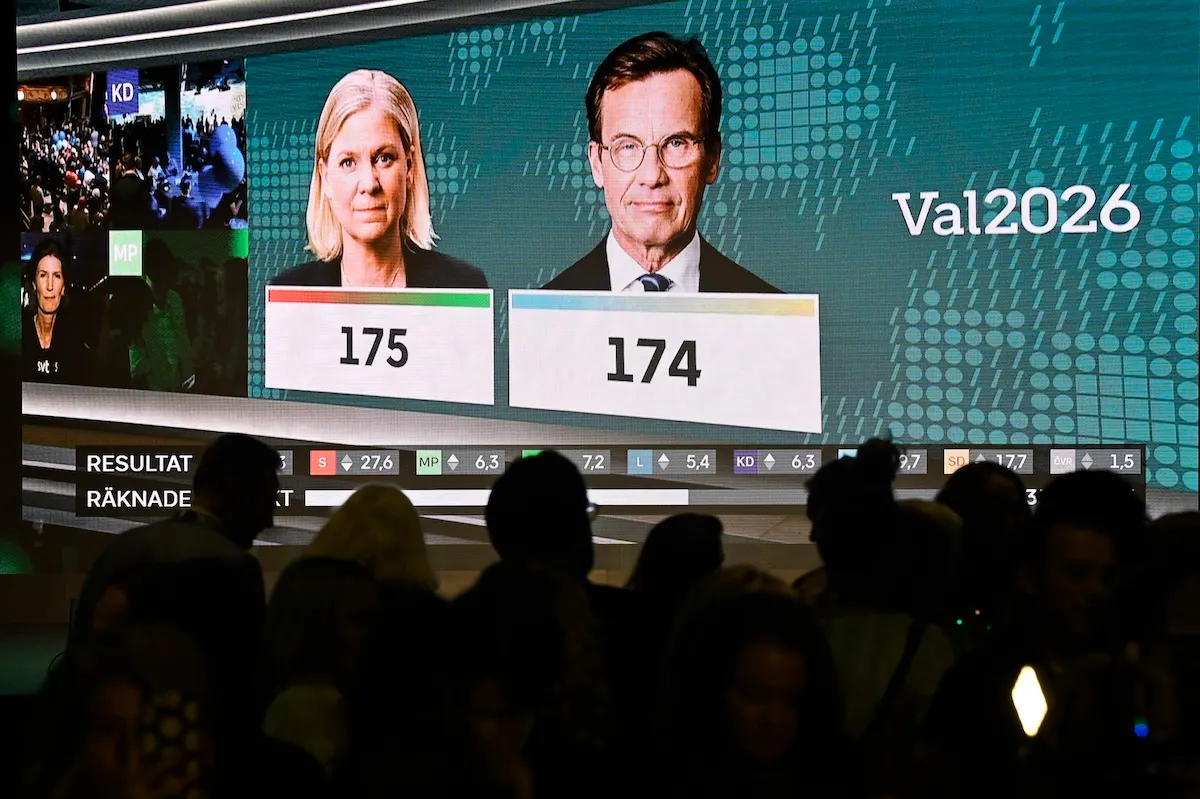
In the week after the election on September 13th, Social Democrat leader Magdalena Andersson was appointed sonderingsperson by the house speaker. This means she gets the first shot at trying to negotiate enough support among the other parties to be tolerated as prime minister in a parliamentary vote.
She has said she is willing to negotiate with every party apart from the far-right Sweden Democrats (although she qualified this by saying that the Left Party has "a long journey to go on" before it should have ministerial positions.
So, what sort of government coalitions might she be trying to form?
According to Johan Hinnfors, Professor Emeritus in Politics at Gothenburg University, it is clear which coalition is top of her list: the Social Democrats, Centre Party, and the Green Party. But will she get it?
What are the options for Social Democrat leader Magdalena Andersson?
1) S C MP (V)
“If she were to choose, she would like to form a three-party government: the Centre Party, the Greens and the Social Democrats, with a confidence and supply deal in writing with the Left Party," Hinnfors told The Local.
This agreement, he says, would "state issue areas where they are to cooperate, and particularly to state that those four parties, the government and the left party, have to agree on the budget.”
This would be a minority government, with a two-seat majority once the votes of its support party are included.
The issue with this constellation (as we have repeated ad nauseum) is that the Left Party refuses to support a government in which it does not have ministers, and the Centre Party refuses to support a government in which the Left Party does have ministers.
One of them, or perhaps both, will need to compromise, and right now, that looks tricky.
Andersson will be hoping that the Left Party will in the end accept a similar position to that held by the Sweden Democrats over the past four years, with officials in parliament, a formal coalition agreement, and perhaps Left Party spokespeople appearing at government press conferences.
If the Left Party was given a big enough policy win – perhaps if the Centre Party agreed to end profit-making at Swedish free schools – might that be enough of a win to allow the Left Party to back down? We shall see.
2) S MP C V
The Green Party has said that its preferred solution is to have all four of the former opposition parties inside the government, which would give the government an even more stable majority than that which the Tidö government has enjoyed. This, however, would require the Centre Party to drop its opposition to Left Party ministers.
Might it agree if the Left Party was given only relatively junior ministers or if the Left agreed in exchange to a thoroughgoing centre-right economic program dictated by the Centre Party?
Hinnfors, however, doubts that the Centre Party would drop its red line whatever it is offered. The party, he points out, has extremely strong finances, meaning it would be more than capable of funding a new election campaign.
“I think it’s more likely that the Left Party is technically outside the government than inside the government."
3) S MP (V C)
Since right now it's looking unlikely that the Centre Party will be willing to have its ministers serve alongside ministers for the Left Party, would the Left Party be willing to support a government in which it does not have ministers if the Centre Party didn't get any either?
Possibly.
In that case, though, the Centre Party would demand policy concessions at least as great as those it won in the 2018 January Agreement, where the Social Democrats agreed, among other things, to scrap the top marginal rate of tax (meaning a tax cut for the highest earners).
In such a scenario, the question is: would the Left Party be willing to support a government with largely centre-right economic and fiscal policies?
4) S (MP, V, C)
An even more radical situation would be a return to the minority single party government that Magdalena Andersson led between November 2021 and October 2022.
This would allow the Social Democrats to resist pressure from the left-wing parties to adopt softer positions on crime and migration, and perhaps even to pass restrictive legislation in these areas with the support of the right-wing parties.
It could then team up with the left-wing parties on issues such as welfare and the environment.
For this to happen, it would require the parties to agree a programme at least as detailed as the Tidö Agreement that spelled out the reforms carried out by the Tidö government. Could the Left Party and the Centre Party agree on this?
5) S C MP KD (L)
In the election campaign, Thand Ringqvist announce her ideal coalition: a centrist government combining the Social Democrats, with the Green Party and the Christian Democrats.
The Green Party's joint leader Amanda Lind quickly ruled this out as "impossible", expressing surprise that Thand Ringqvist thought the Christian Democrats anything but hostile to action on climate change.
Now the result is in, this four-party coalition lacks a majority anyway, meaning it would need to also win the backing of the Liberal Party and both the Christian Democrats and the Liberal Party have also now ruled out either supporting or joining a government led by Magdalena Andersson.
Could they be swayed?
Although Hinnfors rates this as "not likely", he suspects the Christian Democrats could be tempted if the Social Democrats agreed to nationalise healthcare in Sweden, taking control away from the regions.
"I think Ebba Busch might consider some kind of a deal nationalising the big hospitals because that is their number one priority," he said. "If you took the first steps towards doing that, maybe that would be enough for Busch to stomach indirectly supporting the Social Democrats. I don’t think it’s likely, but its not totally impossible.”
That still leaves the Liberal Party, though. As it only managed to stay in parliament thanks to tactical votes from the Moderate Party, Christian Democrats and Sweden Democrats, it is unlikely to then use its seats in parliament to back the other side.
Is there any chance that Moderate leader Ulf Kristersson could form a government?
Ulf Kristersson has clearly not yet given up on another term as prime minister, and his party and its supporters remain hopeful that Andersson will fail to build a workable coalition.
If her candidacy as prime minister is rejected by parliament, as Sweden's acting prime minister, Kristersson is next in line to be sonderingsperson.
So what are his options?
6) M KD L C (SD)
The four Tidö parties who backed Kristersson as PM over the past four years are now two seats short of a majority, so to regain his position, he would need to win over the Centre Party (or else the Green Party).
The Centre Party has long resisted backing a government dependent on the support of the far-right Sweden Democrats, but its language has been shifting, Hinnfors points out.
"If you listen to the Centre Party, they more often say we would like to 'stop the extremist parties from being inside government', and that is of course indirectly saying 'we could accept them as supporting parties'."
This time around the Sweden Democrats have, just like the Left Party, said they will not support a government in which they do not have ministers.
If they back down on this, given their sizeable election losses, might the Centre Party then back or even join a new right-wing government, claiming that it has succeeded in blocking Sweden Democrat ministers?
Hinnfors believes this is just about possible.
This government would, however, be dependent on Sweden Democrat votes for every law it wants to pass, including its budget, and could be toppled in a no confidence vote whenever the Sweden Democrats chose to do so.
7) M KD L (C SD)
For the reason above, the Centre Party might decide also to be a support party, so that the Sweden Democrats are not alone in having a stranglehold on the government.
If it did this, and if the Sweden Democrats and the three government parties then tried to pass illiberal legislation, the Centre Party would be in a position to block them.
This, Hinnfors says, might "do the trick", although he points out that the Sweden Democrats would still be in a powerful position.
"Every vote, every proposal by the government, every majority would have to include the Sweden Democrats. Would they [the Centre Party] be willing to negotiate a budget with them? Because they would have to do that."
The politics professor Nicholas Aylott, and several other experts, argue, however, that the opposition to Sweden Democrat influence is such a core aspect of the Centre Party's identity and such a key requirement for its voters and members that the two governments above are not real options.
What happens if both Andersson and Kristersson fail?
If both candidates to be prime minister fail to build a workable coalition, there's still one other option.
Back in 2018, Centre Party leader Annie Lööf was herself appointed sonderingsperson, although she failed to make her dream of a centrist government a reality. Might her successor, Elisabeth Thand Ringqvist, have more luck? Is there a possible centrist coalition she could build?
8) C KD L MP (M S)
One possibility would be a minority centrist coalition that ruled with the support of both the Moderates and the Social Democrats.
The issue with this would be that such a government would be able to pass bills with the support of the Social Democrats alone, while the backing of the just the Moderate Party would not be sufficient. This might make the Liberals and Christian Democrats see the government as too dominated by the left.
This same thinking would probably rule out the other possible coalition with only the Social Democrats as a support party and both the Moderates and the Sweden Democrats in opposition.
Both the Moderates and the Social Democrats would anyway probably prefer a new election to such a second-fiddle arrangement.
What if all else fails?
If Andersson, Kristersson and Thand-Ringqvist all fail to form a coalition, and there's only one vote left before the Speaker calls an emergency election, there is still one possibility: a 'grand coalition' of the Moderates and Social Democrats.
9) S M C (and/or maybe L or MP)
Such governments are relatively common in Germany and Finland, but have long-been ruled out in Sweden, largely because the Social Democrats have been so dominant historically. The Moderates in particular would risk losing their position as the leading party in their bloc.
Unlike after the 2018 election, this time the Moderates and Social Democrats are also seven mandates short of a majority, so they would need to bring in the Centre Party, or the Liberal Party or Green Party, to be a majority government.
"It's the Dagens Nyheter newspaper's wet dream, but I don't think it's likely," Hinnfors says. "It might be difficult for Kristersson to stomach it."
"But let's say you have a situation where you have three prime ministers proposed by the speaker rejected by parliament, and you're facing a snap election, and there are international tensions or interest rates are going up. You might have a situation where the Moderate Party and the Social Democrats say, 'OK, in the national interest, we will rule together'."
For this coalition to go ahead, the Social Democrats would probably have to sacrifice the prime minister position, either to the Moderates or, more likely, to the Centre Party.
The biggest risk of this coalition is that it would leave the Sweden Democrats as the only sizeable opposition party, potentially gaining it massive voter support.
So unless there is a major crisis, if it comes to this, it's much more likely that there would instead be a new election.
Which coalition would you most like to see and which do you think is most likely? Are there any we missed out? Please tell us in the comments.