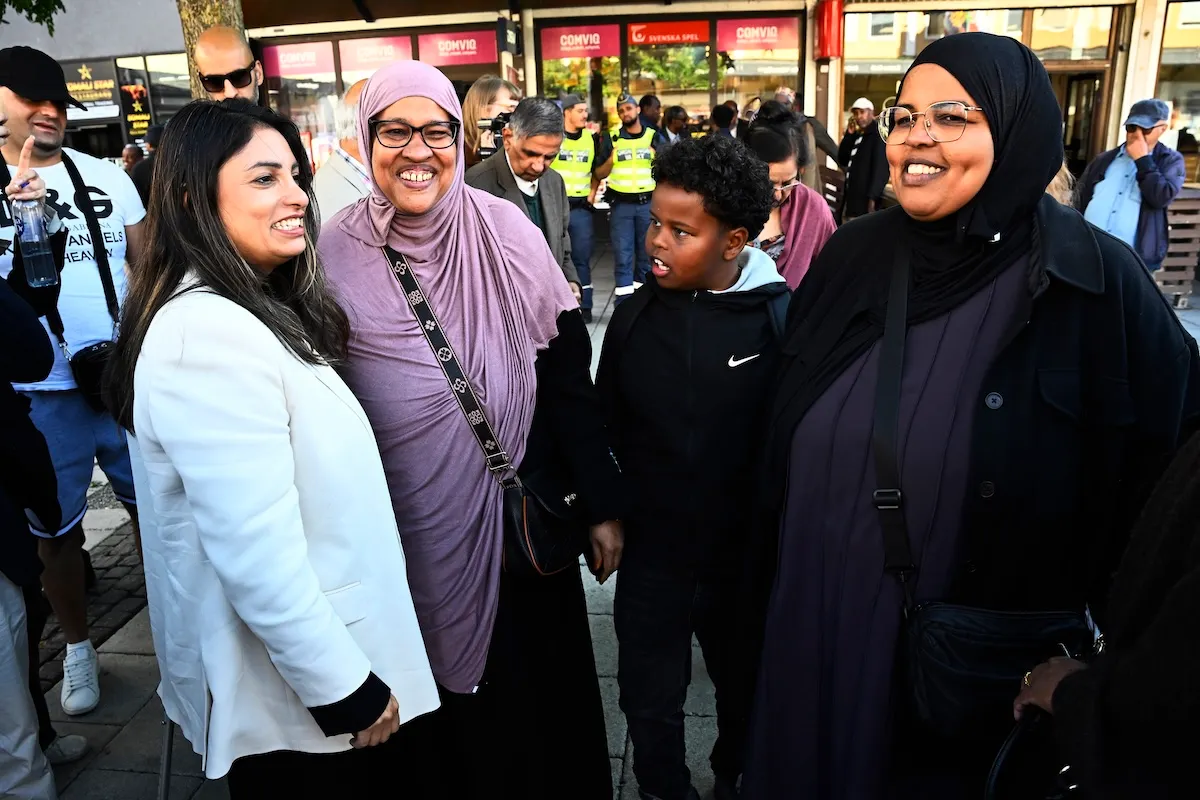
In a post on X made at 1am on election night, Tobias Andersson, one of the Sweden Democrats' top MPs, blamed the Tidö Parties' defeat on the "200,000+" foreigners who had become Swedish citizens since the government took office in October 2022. If the other parties had followed the Sweden Democrats' advice and imposed a total freeze on new citizenships as soon as they took office, he argued, the right wing would have won.
Mattias Karlsson, the Sweden Democrats' international secretary, complained on Facebook that the left-wing opposition had received a massive 97.6 percent vote share in Rosengård, an area of Malmö with a high immigrant population. "North Korea numbers for the left-wing in Rosengård," he wrote, along with an anti-Islamic tirade accusing left-wing politicians of financing mosques and even of wearing the hijab.
Fredrik Kärrholm, a hard-right MP for the Moderate Party, made the same point, describing the Rosengård vote result as "a result that might have made Saddam Hussein jealous" in an article in British right-wing politics magazine, The Spectator.
The government, he said, had made a mistake by not imposing a moratorium on new citizenships.
The Social Democrats' leader Magdalena Andersson called the claim "a conspiracy theory", arguing you could make the same claim about "people from Norrland, assistant nurses, or mariners".
So how much truth is there in the claim?
According to the SVT Valu exit poll, the four Tidö parties – the Moderates, Sweden Democrats, Christian Democrats and Liberals – would indeed have won 51 percent of the vote (compared to 48 percent for the opposition side) if you had taken the decision to only count votes from people with Swedish backgrounds.
But to make a similar argument to Magdalena Andersson's, if all the votes from women had been chucked out, the same parties would have won 55 percent, so they could equally well blame women.
The same goes for blue-collar workers, whose votes would not have been enough for the Liberals to stay in parliament and the right bloc would have lost as a result. Or people over the age of 65, who as a group voted for the left-wing parties.
Also, this does not mean that the Tidö parties have only lost ground among foreign voters. In the 2022 election, a similar decision to disallow votes from people with non-Swedish backgrounds would have netted the four parties 52 percent of the vote.
What about the 'Saddam Hussein' numbers in majority immigrant districts?
If we ignore the fact that Saddam Hussein received 100 percent of the vote in a rigged election, so would hardly have been envious of anything less than that in a democratic election, let's look at the numbers.
In Spånga, one of the voting districts in the Stockholm suburb of Rinkeby, which has a large immigrant population, the Left Party won its own 51 percent majority, while the Social Democrats got 39.7 percent. No other party received more than 3 percent of the vote.
In Biskopsgården Norra, one of the districts in Gothenburg with the largest proportions of people with immigrant backgrounds, the Social Democrats won 43.5 percent and the Left Party 40.4 percent. The next biggest party was the Sweden Democrats on 4.1 percent.
In Rosengård in the city of Malmö, which has been a left-wing stronghold for decades, the Social Democrats won 54 percent and the Left Party 41.2 percent. The next biggest party was the Green Party with 1.4 percent of the vote.
Is it true that there were '200,000 plus' first-time voters with a foreign background?
According to the Swedish Election Authority, there were 271,335 more people eligible to vote in the 2026 parliamentary election than in 2022. We don't know how many of those were new citizens and how many were people who became eligible for other reasons, such as those who turned 18 between 2022 and the 2026 election.
Around 20,000 foreigners got Swedish citizenship in 2022, after the Tidö government took office, 67,789 in 2023, 62,989 in 2024, 37,494 in 2025, with a further 17,851 receiving it in the first half of 2026.
Put together, that's 206,123 newly enfranchised potential voters with foreign backgrounds. What we don't have is any figures for which parties these newly naturalised first-time voters gave their support to.
What do the exit polls say about who people with a foreign background voted for?
One of the most interesting findings of the exit poll is that it wasn't only voters with a non-European background in districts like Rosengård who swung the election for the four opposition parties, but also voters with a background in another European country.
Vote share for the left bloc from voters with a "non-European background" was in fact unchanged from what it had been in 2022, with the Social Democrats, Left Party, Centre Party and Green Party winning a combined 67 percent of the non-European vote in both elections.
The only shifts were within the blocs: In the left bloc, the Social Democrats lost two percentage points and the Centre Party lost 3 percentage points, while the Left Party gained 4 percentage points; on the Tidö side, the Sweden Democrats lost two percentage points among non-European voters, while the Christian Democrats and the Moderates each gained a point.
Where there was a much bigger change was among voters with a background in another European country. The four opposition parties increased their lead on the four Tidö parties in this group by 4 percentage points between 2022 and 2026, giving the opposition a nine-point lead.
At the same time there was a total collapse in support for the Sweden Democrats. The party's share of the vote among European voters plummeted from 21 percent to 14 percent between 2022 and 2026, a drop only partially offset by a three-point gain for the Moderate Party and a one-point gain for the Christian Democrats.
Around 30 percent of the newly naturalised first-time voters in this election have a background in another European country (64 percent have a background outside Europe), so that's nearly 62,000 voters.
In short, the numbers suggest the story is a bit more complicated than what the Sweden Democrats suggest.