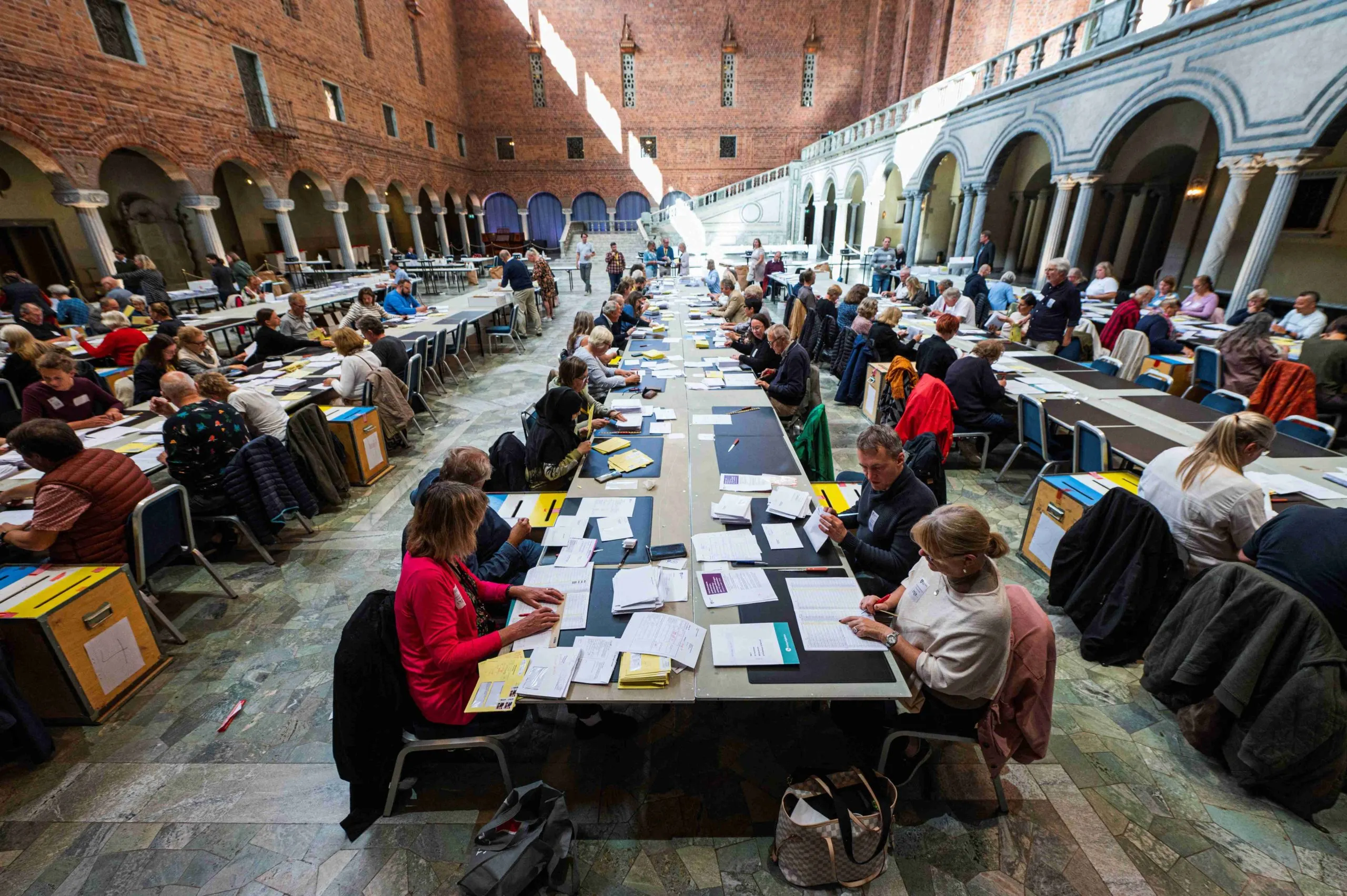
Following Sunday’s general election, we’ve noticed many of you asking about why thousands of votes are being counted days later, with the results not being due to be announced almost a full week after the election took place. Some are inquiring about the possibility of fraud or foul play
So, we thought we’d jump on to explain the process and to put any minds at ease.
Votes get double-checked
The Swedish electoral system has a standard, double-check procedure built into it. According to the Swedish Electoral Authority, “all votes are counted on two occasions. On each occasion, the votes are checked several times.”
This means that with around seven million votes to count, with a record-breaking number of these coming from early and overseas votes, counting them is a time-consuming task.
The process
The process begins on election night, when polling stations close at 8pm. Staff immediately open ballot boxes and conduct a quick preliminary tally for major parties expected to win Riksdag seats, which is what you would have seen on Sunday night if you were following our coverage.
Most early votes cast before Election Day are delivered to the voter’s local polling station in advance and included in this initial tally. To deliver fast election-night indications, potentially invalid or contested votes are put to one side to be assessed during the second, more formal count.
On the Monday morning immediately following Election Day, Sweden’s 21 County Administrative Boards begin the official, final vote count. During this phase, every single ballot paper, including candidate preference votes, is re-checked, validated and then officially counted by hand.
Wednesday counting
Meanwhile, not all advance votes arrive at a voter’s specific home district in time for Sunday night because they arrive late. These votes are valid as they are likely cast on time, but from further afield. So, on the Wednesday after every election, municipal election committees conduct a scheduled preliminary tally specifically for late-arriving early votes.
This extra session, known as Wednesday counting, is a fixed requirement under Swedish electoral law. That’s to say, it’s not a special extension given for this particular election. The Swedish Election Authority aggregates all municipal and county data to formally declare the final distribution of Riksdag seats roughly an entire week after Election Day, while regional and municipal results are finalised even later, at around two weeks after.
There were slight delays
However, this time around, a higher volume of early votes and increased participation among Swedes living abroad meant that votes did take a little longer to go through. For example, as there were more early votes the logistical complexity of routing sealed envelopes back to home districts increased, costing time. A higher-than-average turnout among voters living abroad also meant processing more postal ballots arriving via international mail services.
If you’re still not convinced, luckily the system is designed with full transparency in mind to prevent fraud. While Sweden’s method of using individual ballot papers for each party can lead to manual sorting work for election staff, it does mean that reliance on electronic systems that could be vulnerable to hacking is avoided.
But, most importantly, every step of both the preliminary and final counts is completely open to the public. Anyone, whether they voted or not, is legally entitled to enter a counting room to observe election staff handling, tallying and verifying ballots in real time.