Sweden's Tidö bloc faces '99.9% certain' defeat as final vote count continues
With only five constituencies left to count at 9.15am, public broadcaster SVT's election forecast states that the probability of the centre-left opposition securing the most seats is 99.9 percent.
"It is clear that Tidö will not assemble a majority – there's less than a fraction of a percent's chance according to our simulations. In all material respects, it's done," said mathematician and economist Gustav Karreskog Rehbinder, who developed the forecast model in collaboration with SVT.
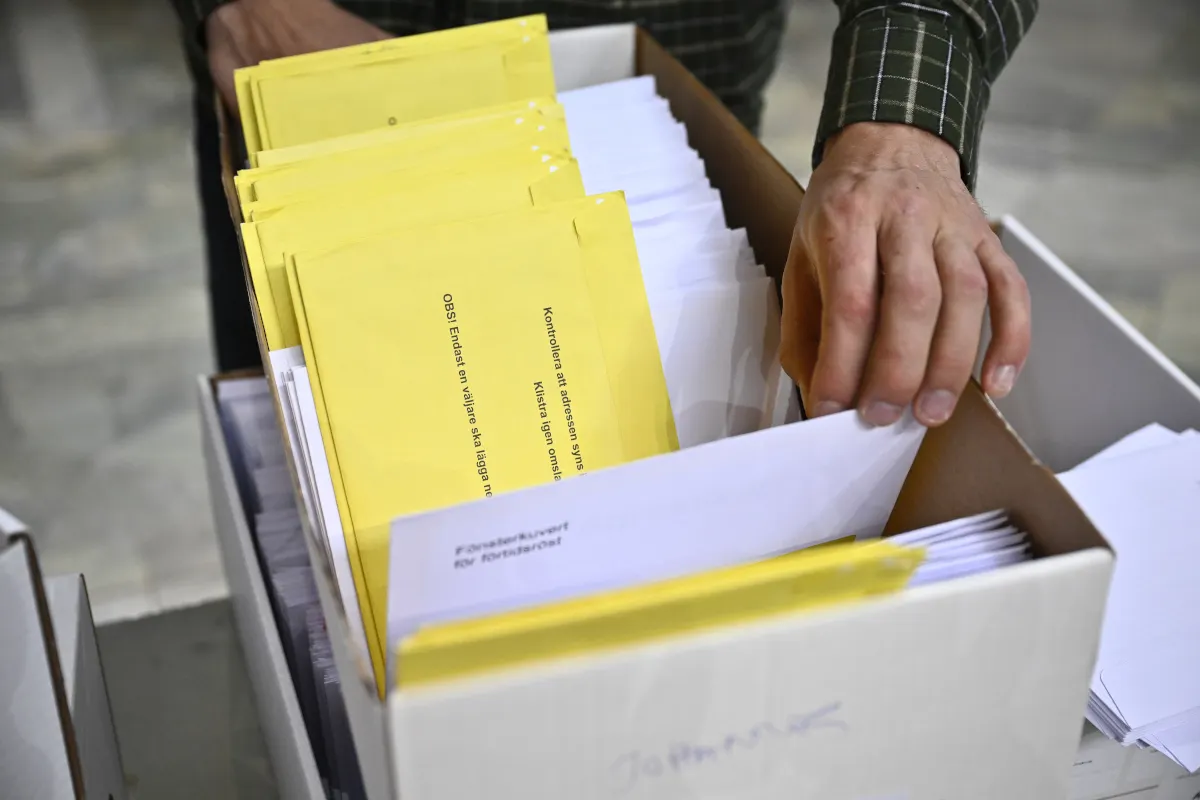
On Thursday morning, counting was still under way for the late-arriving votes from the remaining polling districts. A single seat bounced back and forth between the Social Democrats and Sweden Democrats seven times in just one hour on Wednesday evening. Later in the evening it jumped from the Social Democrats to the Moderates, and then later to the Left Party. At 9.30pm the seat division stood at 176-173 to the left-wing bloc.
The opposition's overall lead against the Tidö parties remained intact the whole time.
"The final seat – whether it ends up as 176 or 175 for the centre-left – isn't certain yet. And it's possible we will need to wait for the final official vote count to know for sure," Karreskog Rehbinder said.
Centre Party leader Elisabeth Thand Ringqvist wrote on X that it is a tight election and all parties need to respect the outcome.
"If the forecast holds, the Tidö parties have lost their governing mandate and Sweden has said no to Sweden Democrat ministers," she wrote. (TT/The Local)
Swedish vocabulary: a lead – en ledning
Higher turnout in 2026 election than in 2022
Turnout in this year's election is higher than in the last election in 2022.
According to the preliminary vote count, turnout stood at 84.3 percent with six constituencies left to count. In 2022 the final turnout was 84.2 percent.
"The count isn't over yet, so it will increase a bit more," an Election Authority press officer told broadcaster TV4. (TT/The Local)
Swedish vocabulary: turnout – valdeltagande
Foreign-born workers help push down Swedish unemployment rate
Unemployment in Sweden is falling slowly, with the biggest decline recorded among foreign-born residents, according to monthly figures from the Public Employment Service.
The gap in unemployment between native-born and foreign-born residents remains wide – at 4.2 percent and 13.4 percent respectively – it is continuing to shrink.
Over the past year, the number of unemployed foreign-born residents fell by 18,000 to reach 179,000 at the end of August. Meanwhile, the number of unemployed native-born Swedes dropped by 4,000 to 170,000.
Overall, 6.5 percent of the workforce – or 349,000 people – were registered as unemployed with the country's job agencies at the end of August. That's a slight improvement compared to 7.0 percent the previous year.
However, the number of people served with redundancy notices rose in August to just over 2,900, representing an increase on recent months, according to seasonally adjusted figures. (TT/The Local)
Swedish vocabulary: slowly – långsamt/sakta
Sweden's southern Kebnekaise peak shrinks further as glacier melt continues
Kebnekaise's southern peak is continuing to melt, according to this year's official measurement.
The ice-covered southern peak of Sweden's tallest mountain was measured at 2,088.3 metres above sea level, a drop of 10 centimetres compared to the same time last year. This leaves the ice-free northern peak, which stands at a permanent eight of 2,096.8 metres, as Sweden's highest point for the eight consecutive year.
"The southern peak has lost roughly 30 metres in height since systematic measurements first began in 1951. While this year's low rate of melting represents a small drop compared to previous years, it is still a decline despite the cold summer," said Johanna Dahlkvist, station director at Stockholm University's Tarfala Research Station, which carries out the measurements.
The rate at which the southern peak melts varies from year to year. Last year it shrank by 1.5 metres, and during the record-hot summer of 2024 it lost 3.4 metres. (TT/The Local)
Swedish vocabulary: the southern peak – sydtoppen
Right-wing politician claims failure to pause citizenship grants cost Tidö coalition the election
The overwhelming support for the Social Democrats and Left Party in the immigrant-heavy Malmö district of Rosengård has stunned Moderate MP Fredrik Kärrholm, whose government in the past four years pulled the rug from under the feet of 100,000 citizenship applicants, raised the work permit salary threshold to levels few will be able to meet, limited the right to free Swedish For Immigrants tuition, oversaw the deportations of hundreds of legal work permit holders after they scrapped the track change system, phased out permanent residency for asylum seekers, made it harder for foreign families to reunite in Sweden, and much more.
Writing in the British magazine The Spectator, Kärrholm argued that it was a mistake for the right-wing Tidö government not to pause the granting of citizenship after taking power in 2022, noting that nearly 200,000 people have become Swedish citizens since then.
"The final election result is not yet clear, but with only around 30,000 votes separating the two blocs, such demographic changes could play a significant role," he argued.
He described the voting figures in several areas with high immigrant populations as "astonishing", adding that the combined total in Rosengård – where the Social Democrats and the Left Party secured over 90 percent of the vote – "would have made Saddam Hussein envious".
Kärrholm argues that it was a mistake not to impose a total freeze on awarding new citizenships while the new and tougher citizenship laws were being prepared.
Public broadcaster SVT has spoken with researchers to assess whether newly naturalised citizens could indeed have tipped the scales in the election.
SVT's exit poll indicates that voters with non-European backgrounds voted for the red-green parties in higher numbers, with the Left Party gaining ground in several underprivileged suburbs. While these votes could mathematically hold major weight, they do not prove that new citizens vote as a monolith, and some may not have voted at all.
"For the group born outside Europe, there are studies indicating a clear preference for parties that spent the last parliamentary term in opposition. However, the group that has just acquired citizenship is broader than that, coming from various backgrounds and regions," Henrik Andersson, an economist at Uppsala University who studies voter turnout among immigrant groups, told SVT. (The Local)
Swedish vocabulary: envious – avundsjuk