How big a lead does the left-wing bloc have?
The four parties supporting Magdalena Andersson are ahead by just over 30,000 votes, which translates into three seats ahead in parliament, with 176 seats to the right wing's 173.
How many votes are left to be counted?
We don't know, but the Swedish Election Authority expects that there are close to 300,000 votes left to count on Wednesday and Thursday, which would be more than previous years.
In 2022, the authority counted around 227,000 extra votes, or 3.5 percent of the total.
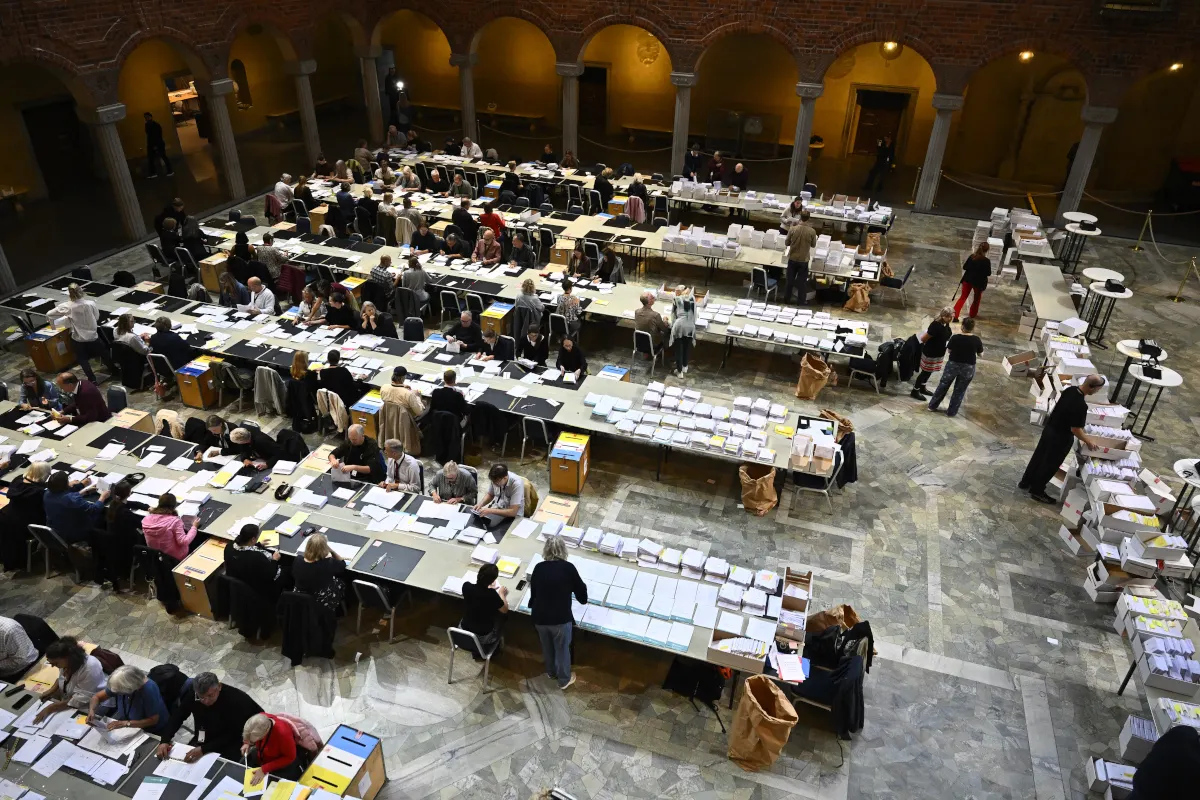
The extra votes – "Wednesday votes" or onsdagsröster as they're often called in Swedish – consist of overseas votes and votes during Sweden's early voting round that were submitted on time, but didn't arrive at their polling station in time to be counted on election night.
ESSENTIAL: All our articles about the Swedish election
Rather than being counted at individual polling stations, these are counted in 314 aggregate uppsamlingsdistrikt, or in English "collection districts", with the finished vote then passed to the county administrative boards, länsstyrelserna in Swedish, for checking.
The reason they're expected to be more than in previous years is partly because of an expected increase in votes from abroad, in combination with a lot of people voting relatively late during the round of early voting, which was open from August 26th-September 12th.
There could also be some votes that were discarded as invalid in the first, preliminary count on election night, but are ruled valid when double checked by the county boards.
Why do people sometimes say the extra votes will benefit the right-wing parties?
It's become a bit of a true-ism in Swedish politics, because it has happened before that Swedes abroad swung the vote. In 1979, the overseas votes sensationally won the election for the right-wing parties, losing Olof Palme his majority in the Wednesday count.
In those years, many overseas Swedes were wealthy right-wing voters who had moved abroad to escape the high taxes brought in by the centre-left Social Democrats.
The only recent hard evidence, however, comes from a 2014 survey of overseas Swedes carried out for the Election Authority by Gothenburg University's SOM Institute.
This showed that the Moderates were over-represented among overseas Swedes and the Social Democrats heavily under-represented, when their voting preference was compared to how these parties did in the election as a whole. But the picture got more complicated once the other parties were brought in.
Among the parties more popular abroad, the Moderates got 36 percent among overseas Swedes compared to 23 percent overall, the Green Party with 12 percent overseas compared to 7 percent overall, the Liberals with 10 percent compared to 5 percent, and Feminist Initiative (whose support has since dwindled) with 5 percent to 3 percent.
- Download The Local's app (available on Apple and Android) and then select "Politics" in your notification options via the user button to get notified every time we publish a politics story we think will be worth your time
Among those who performed worse abroad, the Social Democrats got 15 percent overseas compared to 31 percent overall, the Centre Party 3 percent compared to 6 percent and the Left Party 5 percent compared to 6 percent. But, notably, on the right wing, the Sweden Democrats got only 7 percent among overseas Swedes, compared to 13 percent overall.
The Christian Democrats were as popular abroad as at home.
As you might expect, the survey showed overseas Swedish voters in general favouring economically liberal parties, but it also seemed to show them favouring socially liberal parties, those open to immigration and in favour of taking action on climate change.
Since 2014, the Moderates (as well as the Social Democrats) have become much more hostile to immigration; the Moderates also teamed up with the Sweden Democrats, whom overseas Swedes in 2014 supported to a much lower extent than domestic Swedes.
This makes it far from certain that the parties backing Ulf Kristersson will still have a significant advantage among overseas voters. Also, a lot of the overseas votes came in on time and have already been counted, so if the remaining ones follow the same pattern, we can assume that the current result with the left wing in a three-seat lead will roughly hold.
As for late early voters, there is no conclusive evidence that suggests they generally lean one way or the other.
That said, according to public broadcaster SVT's exit poll, a full two-thirds of Liberal voters made up their minds during the final week before the election or on election day itself, which could perhaps indicate that they might be overrepresented among late early voters.
Among voters for other parties, 47 percent of Christian Democrat voters made up their mind in the final week, 46 percent of Centre Party voters, 36 percent of Green Party voters, 32 percent of Moderate voters, 28 percent of Social Democrat voters, 23 percent of Left Party voters, and only 18 percent of Sweden Democrat voters.
According to a report by the Dagens Nyheter newspaper in 2022, the 'Wednesday votes' usually benefit the Moderates, Green Party, Left Party and Liberals – so that includes two parties from each bloc.
In other words, brace yourselves for a bit of mandatpingis (literally "electoral seat ping-pong"), a word coined to refer to one seat which switches to and from two of Sweden's parties during recounts after an exceptionally close election result. It's possible that the left-wing could lose one seat, but it's unlikely that they're going to lose two.