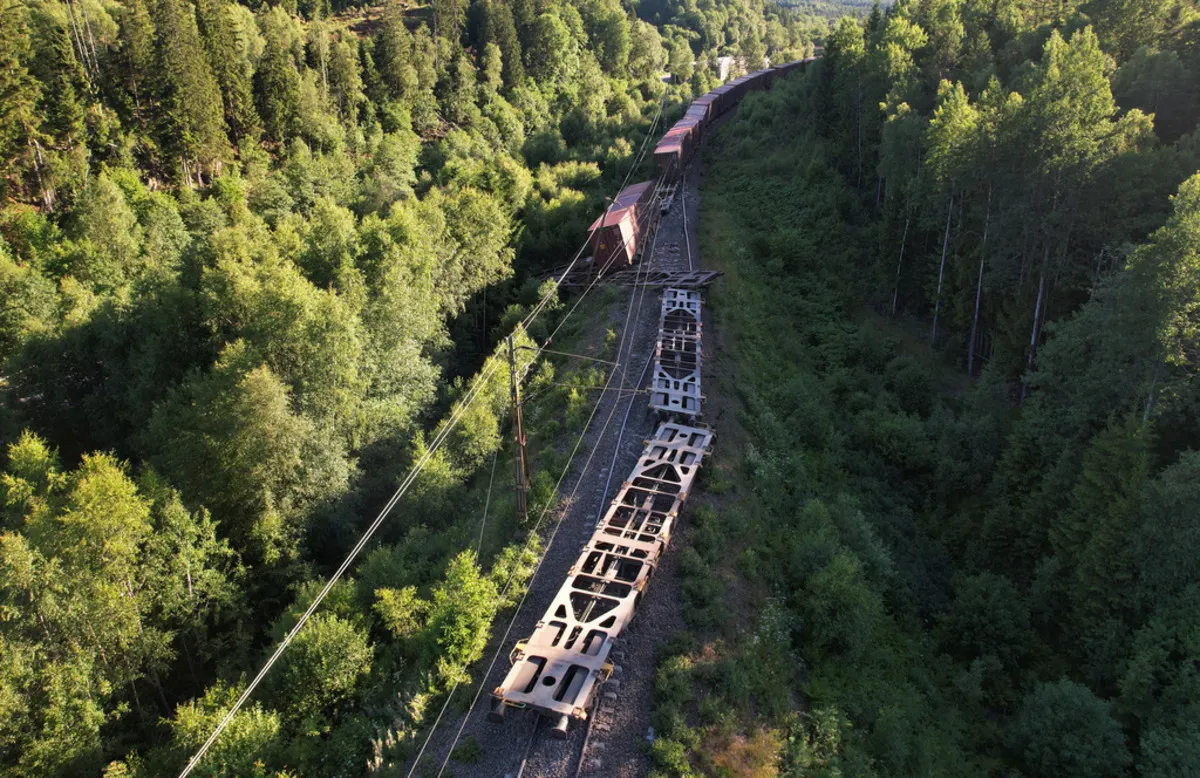
The accident occurred early in the afternoon of Thursday June 25th. About ten carriages were derailed.
The cause of the derailment was believed to be the heat of the sun expanding the tracks.
The Swedish Transport Administration's personnel were sent to the accident site and were able to determine, among other things, that a number of power poles and contact wires have been damaged or fallen down.
The damage will be evaluated in the coming days. The Swedish Transport Administration points out that the terrain is difficult to access and that a large number of carriages have derailed.
"A very rough estimate at this early stage is that the clearance and restoration work is expected to take approximately two weeks," said Hanna Ekberg, section manager at the Swedish Transport Administration, in a press release.
The derailment halts train traffic between Borås and Gothenburg. In addition, train traffic on the Gothenburg–Stockholm and Gothenburg–Kalmar routes is halted.
The reason that train traffic between Gothenburg and Stockholm is affected is that the trains were already running a different route due to track work on the Western Main Line, several media outlets report.
In addition to SJ's trains, several Western trains have been cancelled.
There is no forecast for when trains can start running on the route again.
"All departures are affected," Felicia Palombo Daging at SJ's press service told Swedish newswire TT.
She said that SJ is working to provide replacement traffic and has also applied to reroute train traffic.
"In the [Friday] morning traffic from Gothenburg to Stockholm, we will be able to run two or three trains via Öxnered. And in the afternoon it will be the same thing but in reverse, from Stockholm to Gothenburg, said Palombo Daging.
No people were injured in the derailment and there should be no dangerous goods in the train's cargo, according to the police. A total of 19 departures were affected on Thursday.